Who’s listening to the “life lessons”?

There’s a genre of post that many modern day thinkers/writers, taking the form of N lessons for my Nth birthday. Quick hits, bon mots to celebrate another cycle around the sun and the wisdom gained over a lifetime.

Maybe because my birthday recently passed and I stumbled into some introspection, I found myself thinking about this genre lately. Who’s it for? Who’s reading it? And more, who’s changing their lives because of one of a couple of dozen witticisms?

I recall seeing one some months ago that was posted by someone in their early 30s. My early 30-something self was in the thick of axis-tilting life changes. Ending a 10-year marriage. Starting a new relationship. Embarking in a different direction of my career. I didn’t have the confidence of knowing what I was doing in my own life, let alone to advise anyone else.

A decade later, I’m more comfortable with myself, even through challenges and shifts. And yet I still wouldn’t find ease in distilling what I think I’ve learned into a list of lessons to share with the world. Maybe because so many norms have been upended in this world. Perhaps because I find myself failing to heed my own advice.

But ultimately I know: That’s not how we learn. I wish I could save someone the effort and pain of building that knowledge that eventually finds it home deep in your bones. But the learning is in the process. It’s in the effort. It’s in the frustration, the exhaustion, and yes, in the pain. But it’s also in the confidence and energy and joy it brings.

That’s not to say we have to do this alone. We can learn in community, gain from the collective wisdom of those near and afar. That’s why we read, why we seek advice, why we engage in dialogue with trusted friends and mentors about challenges that lay before us.

It just doesn’t arrive in a bolus of aphorisms. Of course, these posts have their audience. Maybe the collections of lessons offer insights to some. Maybe they’re a byproduct of reflection, written for the writer and merely shared with the world.

Ultimately quips can be easy-to-recall signals to draw our attention, but they’re not the anchors. We all have to find our own way, in our world, in our own time.

Posted in Uncategorized | Leave a comment

Books I read, March 2025

Another month, another 5 print books and 1 audiobook down!

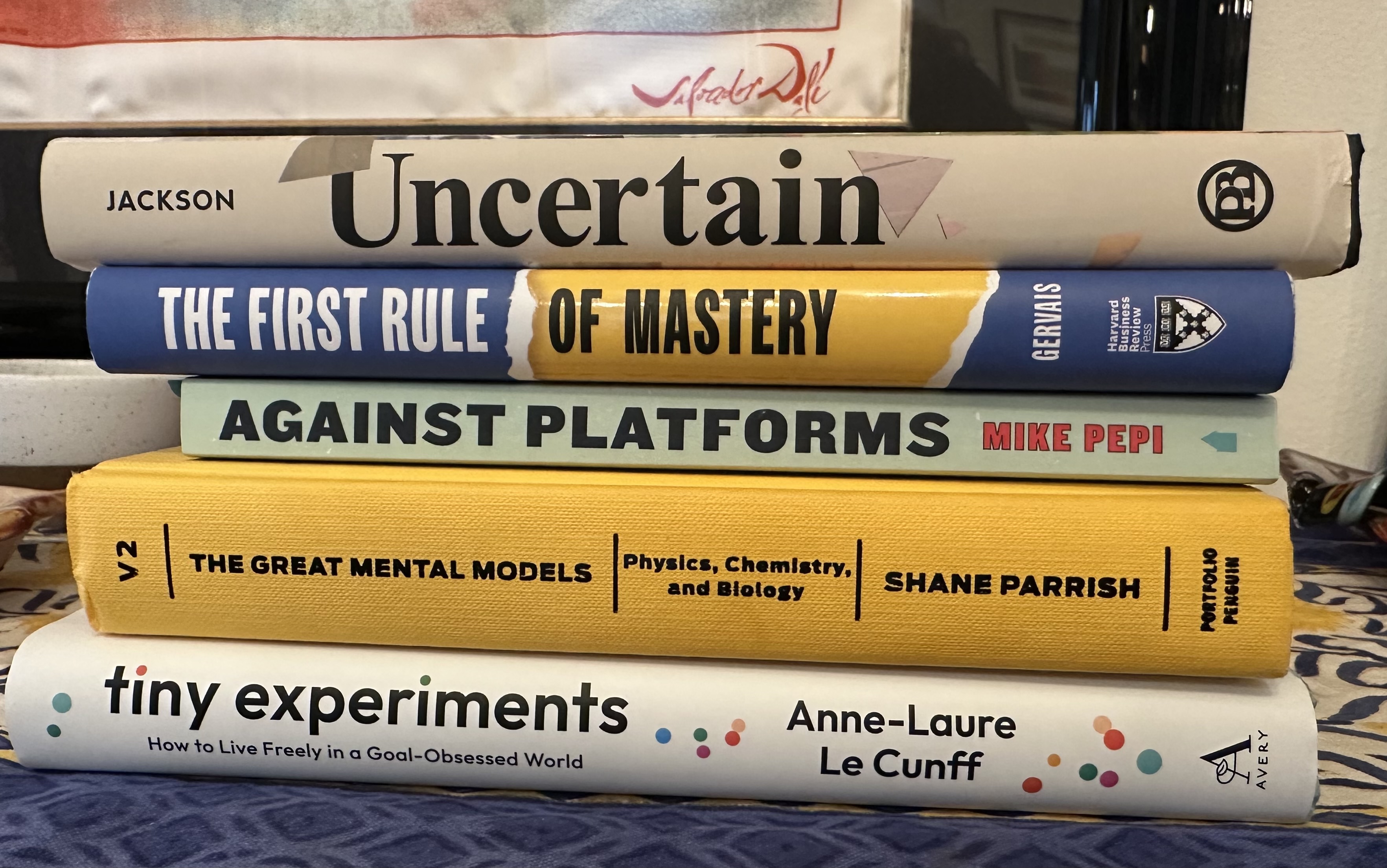
Uncertain: the Wisdom and Wonder of Being Unsure by Maggie Jackson

My favorite read of the month. Jackson dives into the art and science of not-knowing, the space where we are unsure or in the dark. This is about epistemic uncertainty, where we are at the limits of our knowledge demarcating a point where we can learn so much—if we’re willing to endure a bit of discomfort. Jackson looks at uncertainty through different lenses, and throughout, I jotted down notes about the ways that society, technology, and (group) culture select against this state. In a time and place where we’ve become hyperfocused on productivity and efficiency, we risk losing the space for discovery and new approaches, both individually and collaboratively.

“It is not uncertainty that we should fear but a growing reluctance and perhaps a waning ability to seek nuance, depth, and perspective, all fruits of skillfully confronting what we do not know. This path does not offer the easy way out. Uncertainty unsettles us—and that is its gift.”

The First Rule of Mastery: Stop Worrying About What People Think of You by Michael Gervais (with Kevin Lake)

Sometime back, I heard an interview with Gervais and started listening to his podcast Finding Mastery. To my understanding, he’s a leader developing and applying the field of high-performance psychology—using the study of the mind to improve how we show up when it matters, to be our very best. He’s worked with a long list of professional athletes, on the sidelines at UFC matches, NFL games, and the Olympics. In this book, Gervais dives into what he calls “fear of other people’s opinions” or FOPO.

Perhaps because I’ve been listening to Gervais for a while, I didn’t find the book content surprising or groundbreaking. But clearly I connected with the content and found it quotable, based on the highlights in the text. I also like how each chapter ends with an Idea to Action section, providing an exercise to apply the concepts described.

Against Platforms: Surviving Digital Utopia by Mike Pepi

This continues my reading list on the impact of technology on society, and the recent trend of pushing back against the technoutopian view that the machines will make everything better. Pepi is interesting because he identifies as both technologist and humanist. He’s been right there in the midst of Silicon Valley startup world but brings a political historical lens to his critique. He describes our current era of technology as “platform capitalism”, a synthesis of technodeterminism and free-market capitalism that is rapidly trying in replacing institutions—and often succeeding but in ways that leave critical gaps behind. He pushes back on the idea of Web3.0 as a “democratizing” power. Pepi emphasizes that the “enemy” isn’t the technology but the positions of those who employ platforms and algorithms—because ultimately technology is, and always has been, a social practice.

“The belief that any tool is isolated, neutral, and not subject to the worldviews and intentions of those that deploy it is far more dangerous than the idea that said software is itself right-wing or left-wing. Tools do carry inherent biases, but the worst bias lies in the humans that deploy them. We must not accept that a tool improves our lives in the near term and then give up on the continued investigation of its long-term effects of who gets to continue to deploy, innovate, and control such technology.”

The Great Mental Models, vol 2: Physics, Chemistry, and Biology by Shane Parrish

Volume 1 covered general mental models. This volume covered a lot concepts I’m familiar with, having trained in chemistry and biochemistry. But it was fun to see them applied in other ways, and as Parrish laid out connections between the chemical principle of activation energy and human behavior, I could envision the connections to catalysts (which were covered in the next chapter).

Tiny Experiments: How to Live Freely in a Goal-Obsessed World by Anne-Laure Le Cunff

Le Cunff sets up an alternative framework to linear, goal-focused progression through life. I picked up on resonances with Four Thousand Weeks (Oliver Burkeman), Uncertain (Maggie Jackson), The First Rule of Mastery (Michael Gervais), and Cal Newport’s “lifestyle centric planning” (which is the topic of his next release, discussed in his Deep Questions podcast). It also reminded me of Designing Your Work Life by Bill Burnett and Dave Evan, which I read a few years ago.

Le Cunff argues that chasing goals often leaves us unfulfilled when we achieve them and eventually to burnout if we’re constantly pursuing endeavors without clear purpose. She proposes a shift towards “tiny experiments”, finding things that interest you and then creating a pact to take a specific action for a specific period of time without a focus on the outcome. She offers some tools for planning, acting, and reflecting so that each experiment creates an opportunity to learn and grow.

I like the concepts (and already have some embedded in my life). I had planned to take on a pact, but the latter part of March ended up being more uncertain and chaotic than expected—so I’ll come back to this when I have the bandwidth for a little more play and reflection.

Audiobook of the month

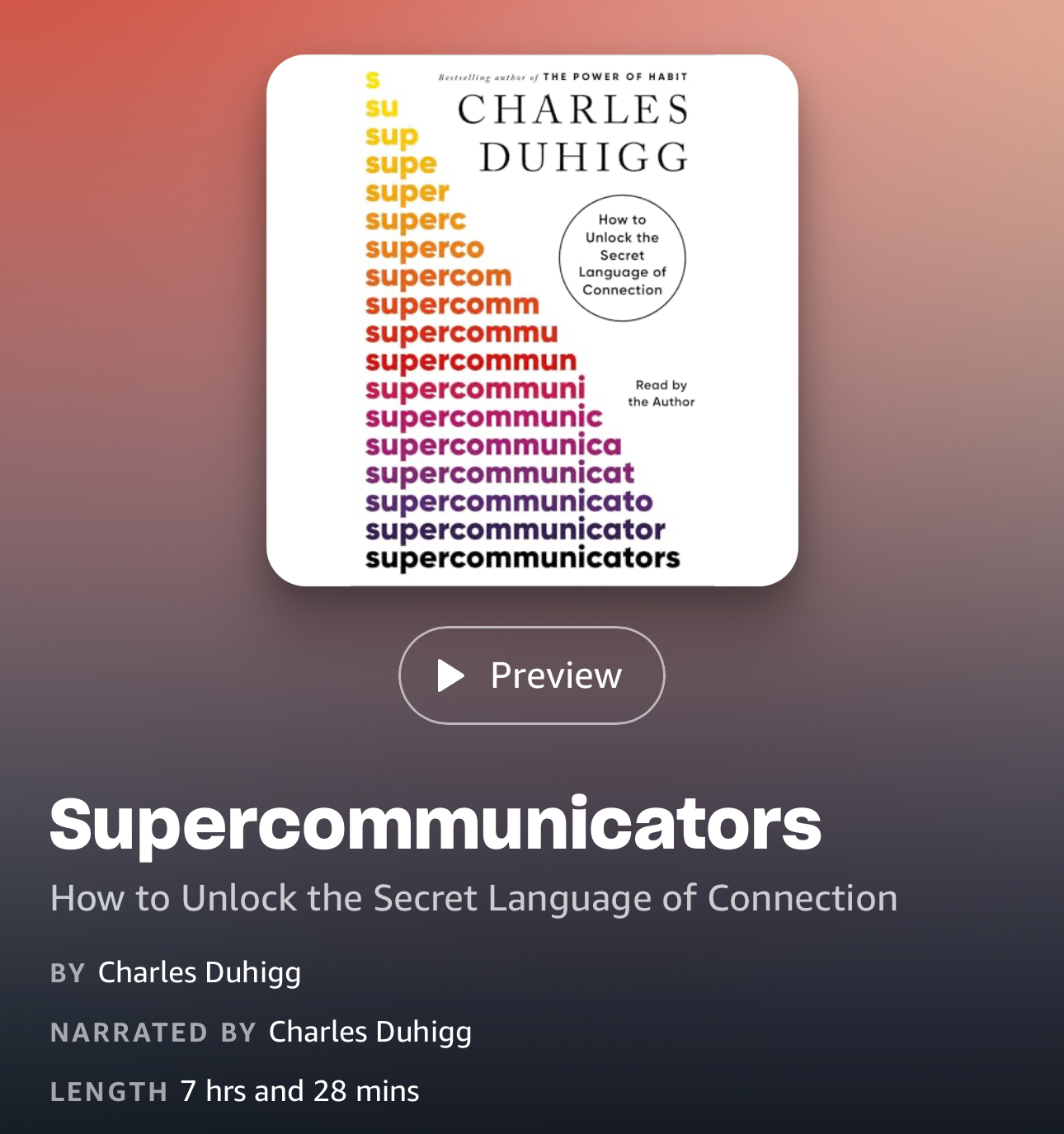
Supercommunicators: How to Unlock the Secret Language of Connection by Charles Duhigg

As a journalist, Duhigg does a stellar job weaving together fantastic stories with expert insights and research to offer lessons on communication. The heart of Supercommunicators is understanding and aligning to the type of conversation your communication partner is having. Duhigg argues that communication boils down to 3 types of conversations: practical (problem solving), emotional (seeking empathy), and social (relating to others). He suggests that communication often fails because parties are having different types of conversations—for example, your partner wants to vent and feel heard, but you go into suggesting solutions. There are also practical tips for improving communication, such as mirroring and looping for understanding.

This is a book I might come back to in print form, since I feel like I miss a lot of information and nuance in audio versions.

Posted in Uncategorized | Tagged , , , , | Leave a comment

Honing the edge

There are things you expect to tire you out, to wear you down, as you work through the days and the years.

The hours when they run long.

The push to meet deadlines.

The intensity of deliverables with high pressure outcomes, like the grant that keeps you and a few or dozens others employed.

Then there are the things no one seems to mention. Not until you’re in it. And even then, only in sacred spaces—the brief confessional of connection. Where maybe you let the mask slip. Where maybe the mentor, the confidante shows a crack so you can too.

The social drain of “stage” presence.

The fatigue following facilitation.

The emotional labor of the empathetic. Of being present for others in their fears and anxieties—even as you hold your own closely.

The tension of holding authenticity, awareness, and reassurance in uncertain times.

But there is something else. There has to be for you to persist. To keep coming back, despite the tax.

The satisfaction of success, or even just a heartfelt “well done.”

The privilege of trust.

The courage of connection.

The knowledge—or at the very least hope—that you showed up in a way that let someone release a little bit of their load.

Think of the a blade. The tool that’s most effective when sharp. The process to create that state requires shaving layers from an edge. Sometimes the friction that seems like it’s wearing you down is actually making you ready for what’s ahead.

Posted in Uncategorized | 1 Comment

Books I read, February 2025

This month I wrapped up 5 books and finished my first audiobook listen! Here’s the rundown.

Nexus: A Brief History of Information Networks from the Stone Age to AI

Harari is a master at telling compelling stories over the long arc of history. I mean, who’d have thought a chapter entitled “Documents” would be so fascinating? Harari positions information flow and control as a central thread of human history, from establishing the possibility of far flung kingdoms to democracy to dictatorships. He pushes back again the techno-optimistic view that more information accessibility should be an unfettered benefit, and it’s hard to argue against him as we’ve seen things play out in recent years. I admit, I was not prepared for the turn to Democracy & Dictatorships—especially as it read so presciently of things we’re experiencing now. Harari paints many possible futures for humanity with the rise of AI, and it should create some urgency for policymakers and the public to create some guardrails.

Superbloom by Nicholas Carr

This was a fascinating and poignant read, and an incredible pairing to read while listening to Nexus. Carr uses a desert Superbloom event that yielded an influencer overrun as a snapshot to illustrate how communication technologies can drive us apart. But he goes back further—and deeper—tackling how each communications breakthrough brought optimism, fear & challenges. He highlights how media change the very ways we communicate, not just technologically but linguistically & socially too. He also shows how slowly & poorly our regulatory bodies adapt to new modes of communication. Carr tells how every leap forward was heralded by some as the invention that would lead to utopia, yet the increased speed and reduced friction often has the opposite effects. (Fun fact: Margaret Mead proposed a network for communication that sounded an awful lot like the internet. The tech just hadn’t arrived yet.)

Tools of Systems Thinkers by Albert Rutherford

This one fell a bit flat for me. It offers some useful concepts/tools, but the format and writing didn’t quite land.

If you want an intro to systems thinking, go for Donella Meadows’ Thinking in Systems — one of my favorite books of all time, period.

Leading Below the Surface: How to Build Real (and Psychologically Safe) Relationships with People Who Are Different from You by LaTonya Wilkins

Wilkins positions authentic, supportive, deep relationships as the key to transformative leadership. And I don’t think she’s wrong. She sets up a framework for REAL leadership—relatable, equitable, aware, loyal. She also makes a case that this type of leadership is foundational to improving equity and belonging in the workplace.

Everybody Needs an Editor: The Essential Guide to Clear & Effective Writing by Melissa Harris and Jenn Bane

A quick guide to improving your writing and avoiding common pitfalls. Though it mostly focuses on professional communications, it also touches on the personal as well. It will be a nice little reference book for my team and me.

Powered by Me: From Burned Out to Fully Charged at Work and in Life by Neha Sangwan

This is almost a how-to guide to being human, when you’ve eliminated so many boundaries that you are skidding towards exhaustion and burnout. It covers a lot of ground, from sleep and movement to core values and purpose. There are lots of assessments and worksheets to help along the way, and some powerful stories too. I was familiar with many of the key ideas, but often authors focus on one aspect, not the full spectrum of how we gain or drain energy. Sangwan trained as a physician and also brings in concepts from functional and Ayurvedic medicine. The latter admittedly sets off my skeptic senses, but I’m trying to keep an open mind.

Posted in Uncategorized | Leave a comment

Books I read: January 2025

This Is Strategy by Seth Godin

I somehow got plugged into Godin’s work several years ago, and I’ve admired how he can mold key insights into pithy, powerful posts. This Is Strategy is brilliant & timely. It’s about systems & time & projects & people. It offers repeated reminders of simple questions that are so often lost as we’re plowing ahead: Who’s it for? What’s it for? A great read regardless of whether you’re new to or experienced in strategy work.

Meditations for Mortals by Oliver Burkeman

Burkeman structured this book as a deliberately paced journey. Divided into 4 sections, each 7 chapters just a few pages in length, the idea is to read a single chapter each day and build towards confronting, even embracing, the finitude of life. (If you grew up in a religious household as I did, you might feel some similarity with the daily devotional.)

I chose to move through this at the recommended pace. I also elected to write a brief reflection/reaction after each reading. Having just read Four Thousand Weeks at the end of the year, the concepts felt familiar, with some new insights & anecdotes, but slowing down the pace lended deeper personal engagement with them. Highly recommend!

Defy: The Power of No in a World That Demands Yes by Sunita Shah

IMO, this should be on everyone’s reading list, now more than ever. Shah trained as a physician and is now a researcher in organizational psychology investigating influence & what drives us to comply. She lays out a definition of defiance, not as a lack of obedience but of rejecting demands & actions that don’t align to our core values. Shah presents a framework for defiance (a true no) paralleling that of consent (a true yes) which she clearly distinguishes from compliance (going along with something without, e.g., the knowledge or autonomy to make an informed decision). She also highlights how defiance is an action, not a trait, that exists along a spectrum. Not all defiance looks like rebellion (and indeed rebellion isn’t always defiance). I learned a lot of science, and this book is changing my thinking in decision making and showing up in the world.

Resilience That Works: Eight Practices for Leadership and Life by Marian Ruderman, Cathleen Clerkin & Katya Fernandez

This comes from the Center for Creative Leadership and is a quick, practical read. It tackles the topic of resilience and what we can do as part of our everyday to help us better respond to the chronic and acute stresses of work and the rest of life. There’s a lot here that I already practice, but there were good nudges and reminders of areas I could tap into more. It ends with an exercise to help you get very tactical in growing resilience practices. Definitely valuable if you find yourself saying you don’t have time for such practices.

Subtract by Leidy Klotz

Loved this book! Klotz has a fascinating background—former pro soccer player, trained in architecture & engineering, collaborating with psychologists & other distant fields. He’s an exemplar of the interdisciplinary researcher, and he’s a fantastic writer to boot. The central premise is that, in attempts to fix or improve things, humans overwhelmingly try adding & are incredibly prone to ignoring opportunities to remove something, even when it would deliver objectively better results. Klotz lays out the driving factors—biological, psychological, societal—and ways to nudge us towards considering subtraction. This isn’t about minimalism. It’s about learning to recognize different ways to change systems.

This Ordinary Stardust by Alan Townsend

Wow. This was devastatingly beautiful. Townsend is an ecosystem ecologist, and the book is a remarkable blend of science communication & memoir. He draws on several scientific fields to tell a story of a changing world, which becomes a doorway to his personal story of moving through the world with trauma and grief. The writing is polished, but Townsend doesn’t sand down the edges of his experience or emotion. It’s a brilliant read that cuts deeply.

Posted in Uncategorized | Leave a comment