
This edition of What I Read covers two months—in part because I only finished one book in November, even though I read a lot! But I had conference travel, then vacation in November, and I can only take so many books when I travel (yes, I’m a Luddite who prefers physical books). Some books were ‘paused’, others picked up and finished off that had been lingering a while.
The Vacation Reads
I went with soft cover/paper back for our trip to New Zealand. We were away for 2-1/2 weeks, so I was in danger of running out of reading and picked up a couple of new reads in fabulous local book shops.
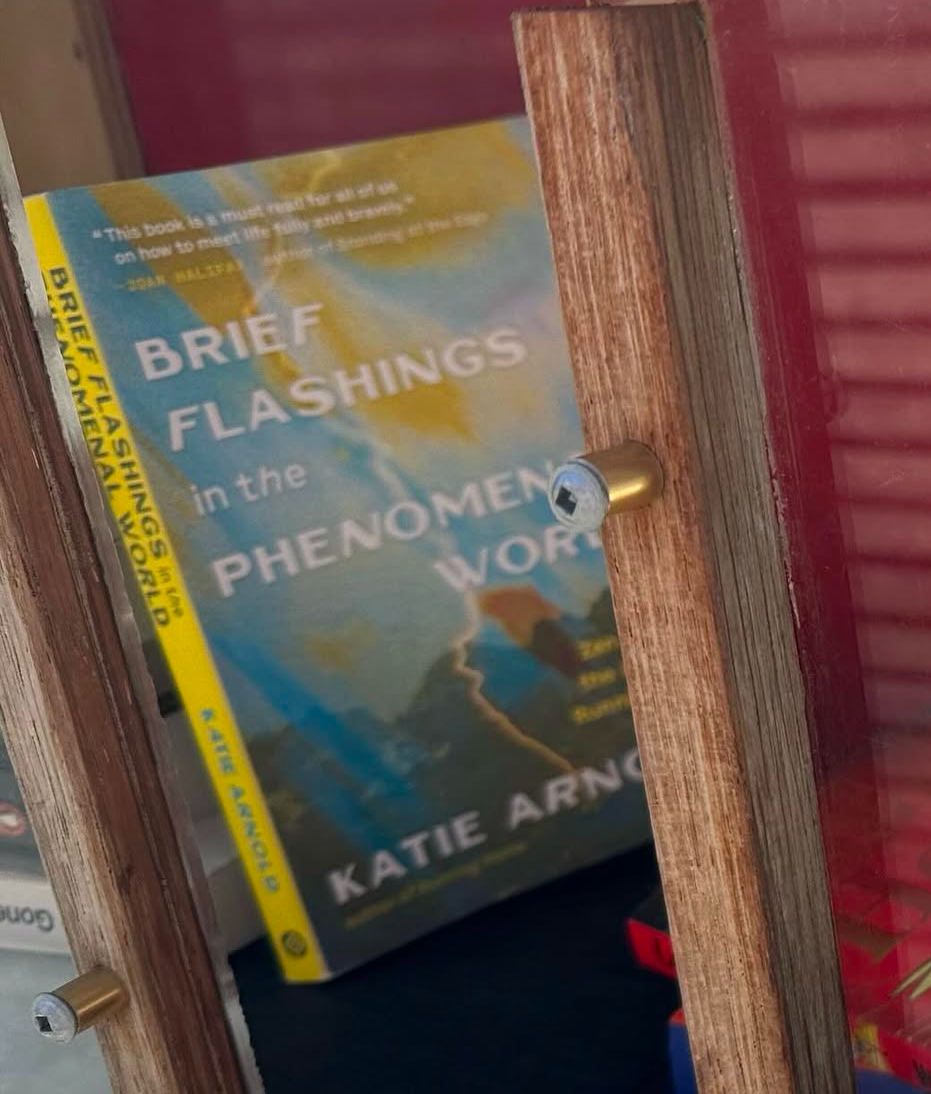
Brief Flashings in the Phenomenal World by Katie Arnold
I left this one behind in a little lending library in Wanaka because it was such a fantastic read. It’s part memoir, part Zen philosophy. Katie Arnold is an ultrarunner and writer. This book centers on a whitewater rafting adventure that goes awry—when Katie breaks her leg just a couple of miles in but continues the almost weeklong journey anyway. It jumps around in time, covering life & sport, being in relationship with others, loss & recovery. If you’re an adventurer, an athlete, or just someone who’s dealing with the unexpected in life, check it out.
Four Thousand Weeks: Time Management for Mortals: Time Management for Mortals by Oliver Burkeman
I’d resisted picking this book up for 3 years. I’m not quite sure why, because several thoughtful people (both public podcasters/writers & friends) raved about about it. I think I saw it as a time management book & felt like I didn’t need/want that. But then Burkeman was making the rounds for his latest book & his perspectives resonated. So I decided to dive into 4000 Weeks. I found that it was so much more than a “time management” book. It’s history & philosophy & anthropology, leading not to a slate of tactics to be more “productive” but an invitation to see & experience time in a different way. It’s the anti-time management productivity book.

Rules for the Dance: A Handbook for Writing and Reading Metrical Verse by Mary Oliver
Earlier this year, I decided I wanted to bring more poetry into my reading. Mary Oliver was a name that frequently popped up. So I was delighted to find her book that provides a grounding and analysis of elements of metered poetry. I’ll never remember all the terms, but it lends a greater appreciation of what it takes to write good poetry. And Oliver’s prose is as beautiful as her verse. The second half of the book is a wide ranging anthology of metrical poems.
Twelve Moons by Mary Oliver
Continuing the theme of reading more poetry, I’d also picked up one of Oliver’s collections. All grounded in nature, some were playful, others filled with wonder, and some simply gut wrenching. Raccoons was perhaps my favorite.
We Will Not Cancel Us: And Other Dreams of Transformative Justice: Breaking the Cycle of Harm by adrienne maree brown
amb has been a leader in social movements & writes elegantly & compellingly about imagining & cultivating different ways of being in relationship with others, our systems, our worlds. She released this short set of essays, building on a blog post published in 2020. It’s a thoughtful exploration of what happens in the wake of callouts, particularly in the online era.
The Whale Rider by Witi Ihimaera
I don’t read lead a lot of fiction these days, but my god, this was blow-me-down good. It’s a classic work of Kiwi literature that I picked up on our last day in Auckland. First published in 1987, Ihimaera weaves together a story of Māori culture & legend, of leaving & returning home, of racism & patriarchy, of generations & family conflict, of preserving culture & environment in a rapidly changing world. All this through a tale of a young girl finding her power told by an older uncle growing up in a different way. A stunningly beautiful piece of magical realism. It took me less than a day to read it, just couldn’t put it down.
Silence in the Age of Noise: In the Age of Noise by Erling Kagge
Imagine walking across a frozen expanse, for weeks, with nothing but your own thoughts for company. Kagge, an eclectic explorer, chose this path on his trek across Antarctica—-and it drives this series of meditations on the noise of the world & our struggle to go inward & be with ourselves. Essays interwoven with art, it’s another quick read, but broken into brief pieces so you could easily approach it as a short daily read if preferred. I found this one at The Next Chapter, an absolutely delightful bookstore in Wanaka.

The pre/post-vacation reads
I started the first couple of these before travel, but they were a bit heavy (figuratively/literally) for vacation. So here we’re back to our regularly scheduled programming, so to speak.
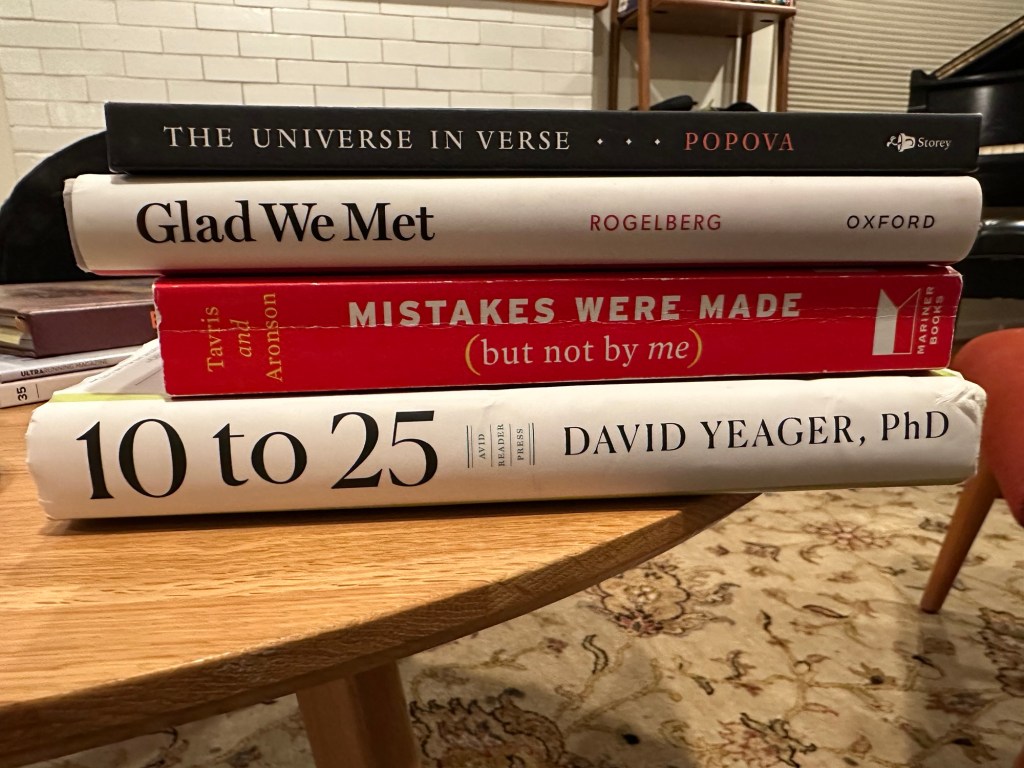
Mistakes Were Made (but Not by Me) Third Edition: Why We Justify Foolish Beliefs, Bad Decisions, and Hurtful Acts: Why We Justify Foolish Beliefs, Bad Decisions, and Hurtful Acts by Carol Tavris, Elliot Aronson
This is a deep dive into understanding dissonance reduction, why & how humans mitigate the identity threat of errors, mistakes, actions misaligned with our values. It looks at why self-correction & admission of mistakes is so difficult. I’ll admit, there were times the book felt a bit repetitive, as it illustrated its point across different domains, but I think the repetition was valuable in illustrating the impact of these failures at individuals, social & societal levels. It ends on a tough note—the final chapter, added in the third edition, about democracy & demagogues was written in Dec 2019, so it felt heavy after the 2024 election.
The book ultimately offers some hope in examples of people who broke free of the self-justification cycle & made significant course corrections. In short, evidence isn’t going to save us. It takes connection & curiosity, the very things we seem to be withdrawing from at a societal level.
10 to 25: The Science of Motivating Young People: A Groundbreaking Approach to Leading the Next Generation for Managers, Parents, and Educators by David Yeager
What does it take to get youth & young adults to make “good” decisions & strive for excellence? This is the central question, a focus of Yeager’s psychology research. The premise is that we’ve historically viewed this age group as incapable of making choices that are good/healthy in the long run because their brains are awash in hormones & not fully developed. Yeager argues for a different model: that 10 to 25 year olds are trying to find their place in their tribe(s) & are striving for status. He establishes the concept of the “mentor mindset”, setting high standards for young people but also providing high support to encourage striving & achieve competence in their endeavors.
Similar to the one above, this book began to feel a bit repetitive at times. I think it’s a trap/feature of many books written by academics for broad audiences. They succeed in making the content accessible but, in covering extensive evidence, are replaying variations on a theme. (I get it, because I can fall into this trap too.) A major plus of this book is highlighting a few simple interventions that can have significant effects on shifting behaviors in this group, such as the feedback note that states you’re giving the feedback because you believe they’re capable of attaining high standards. And some of the lessons for the younger age group can, I think, also support older groups too.
Overall I think this is a good read for those teaching, mentoring, or managing younger folks.
The Universe in Verse by Maria Popova
This is a lovely anthology of poetry, each work paired with art and a short essay about the wonder of the world and science. It’s about the people behind the science and the poetry, as much as the science itself. Pick this up if you need little doses of awe and delight.
Glad We Met: The Art and Science of 1:1 Meetings by Steven G. Rogelberg
Rogelberg is an organization psychologist known for his research on meetings. The book, though, could’ve used an(other) editorial pass—there were a few obvious errors that I found distracting as I read. But the content was interesting & useful. This book focuses almost exclusively on 1:1 meetings between managers and their direct reports. It first presents the case for 1:1s & how they can improve employee engagement. Then it goes into strategies for creating connection & value in these meetings, starting with a focus on the reports’ needs. There are lots of great tips & tools, some of which I’ll be bringing into my existing 1:1s.


 Ever on & on