
Another month, another 5 print books and 1 audiobook down!
Uncertain: the Wisdom and Wonder of Being Unsure by Maggie Jackson
My favorite read of the month. Jackson dives into the art and science of not-knowing, the space where we are unsure or in the dark. This is about epistemic uncertainty, where we are at the limits of our knowledge demarcating a point where we can learn so much—if we’re willing to endure a bit of discomfort. Jackson looks at uncertainty through different lenses, and throughout, I jotted down notes about the ways that society, technology, and (group) culture select against this state. In a time and place where we’ve become hyperfocused on productivity and efficiency, we risk losing the space for discovery and new approaches, both individually and collaboratively.
“It is not uncertainty that we should fear but a growing reluctance and perhaps a waning ability to seek nuance, depth, and perspective, all fruits of skillfully confronting what we do not know. This path does not offer the easy way out. Uncertainty unsettles us—and that is its gift.”
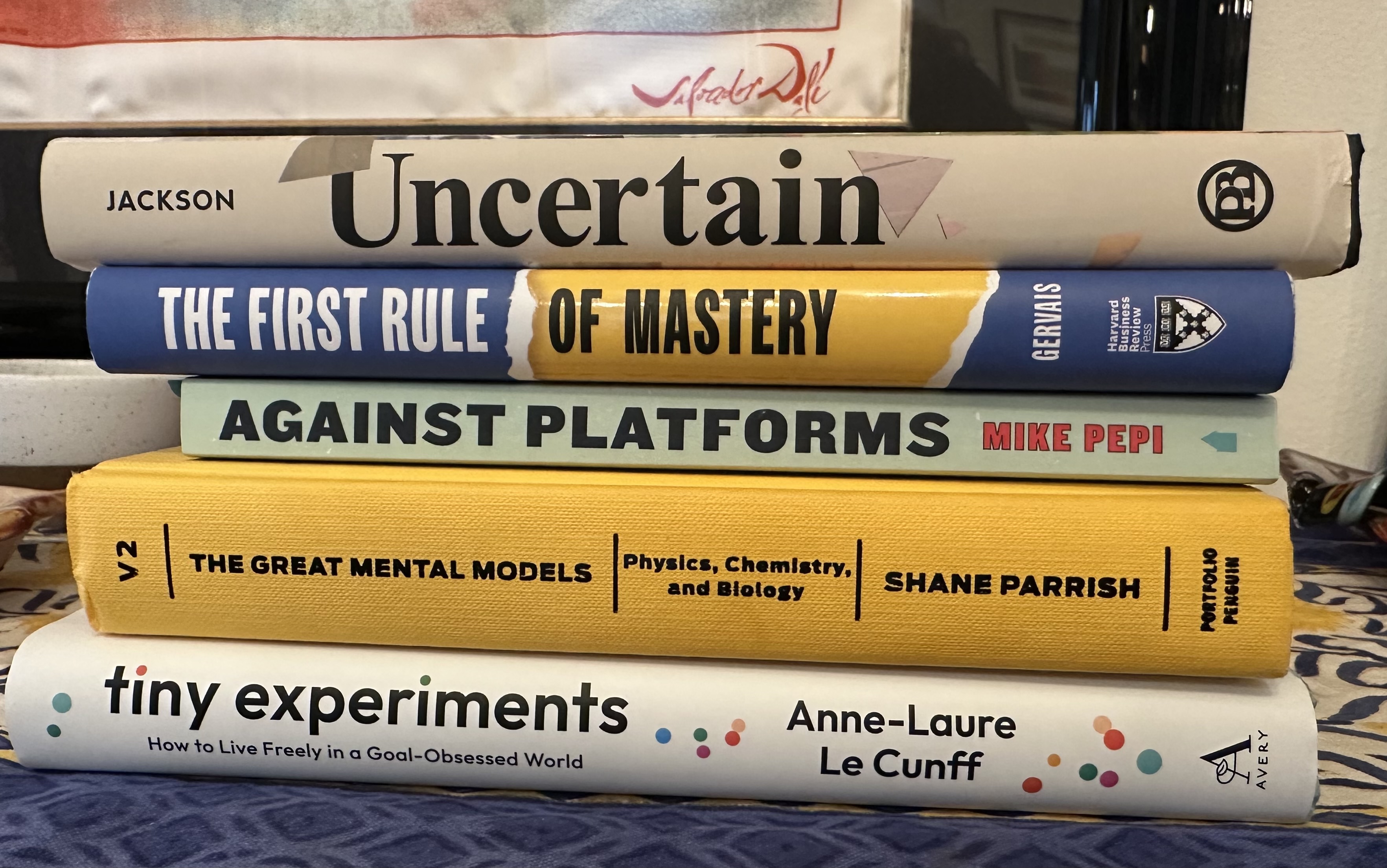
The First Rule of Mastery: Stop Worrying About What People Think of You by Michael Gervais (with Kevin Lake)
Sometime back, I heard an interview with Gervais and started listening to his podcast Finding Mastery. To my understanding, he’s a leader developing and applying the field of high-performance psychology—using the study of the mind to improve how we show up when it matters, to be our very best. He’s worked with a long list of professional athletes, on the sidelines at UFC matches, NFL games, and the Olympics. In this book, Gervais dives into what he calls “fear of other people’s opinions” or FOPO.
Perhaps because I’ve been listening to Gervais for a while, I didn’t find the book content surprising or groundbreaking. But clearly I connected with the content and found it quotable, based on the highlights in the text. I also like how each chapter ends with an Idea to Action section, providing an exercise to apply the concepts described.
Against Platforms: Surviving Digital Utopia by Mike Pepi
This continues my reading list on the impact of technology on society, and the recent trend of pushing back against the technoutopian view that the machines will make everything better. Pepi is interesting because he identifies as both technologist and humanist. He’s been right there in the midst of Silicon Valley startup world but brings a political historical lens to his critique. He describes our current era of technology as “platform capitalism”, a synthesis of technodeterminism and free-market capitalism that is rapidly trying in replacing institutions—and often succeeding but in ways that leave critical gaps behind. He pushes back on the idea of Web3.0 as a “democratizing” power. Pepi emphasizes that the “enemy” isn’t the technology but the positions of those who employ platforms and algorithms—because ultimately technology is, and always has been, a social practice.
“The belief that any tool is isolated, neutral, and not subject to the worldviews and intentions of those that deploy it is far more dangerous than the idea that said software is itself right-wing or left-wing. Tools do carry inherent biases, but the worst bias lies in the humans that deploy them. We must not accept that a tool improves our lives in the near term and then give up on the continued investigation of its long-term effects of who gets to continue to deploy, innovate, and control such technology.”
The Great Mental Models, vol 2: Physics, Chemistry, and Biology by Shane Parrish
Volume 1 covered general mental models. This volume covered a lot concepts I’m familiar with, having trained in chemistry and biochemistry. But it was fun to see them applied in other ways, and as Parrish laid out connections between the chemical principle of activation energy and human behavior, I could envision the connections to catalysts (which were covered in the next chapter).
Tiny Experiments: How to Live Freely in a Goal-Obsessed World by Anne-Laure Le Cunff
Le Cunff sets up an alternative framework to linear, goal-focused progression through life. I picked up on resonances with Four Thousand Weeks (Oliver Burkeman), Uncertain (Maggie Jackson), The First Rule of Mastery (Michael Gervais), and Cal Newport’s “lifestyle centric planning” (which is the topic of his next release, discussed in his Deep Questions podcast). It also reminded me of Designing Your Work Life by Bill Burnett and Dave Evan, which I read a few years ago.
Le Cunff argues that chasing goals often leaves us unfulfilled when we achieve them and eventually to burnout if we’re constantly pursuing endeavors without clear purpose. She proposes a shift towards “tiny experiments”, finding things that interest you and then creating a pact to take a specific action for a specific period of time without a focus on the outcome. She offers some tools for planning, acting, and reflecting so that each experiment creates an opportunity to learn and grow.
I like the concepts (and already have some embedded in my life). I had planned to take on a pact, but the latter part of March ended up being more uncertain and chaotic than expected—so I’ll come back to this when I have the bandwidth for a little more play and reflection.
Audiobook of the month
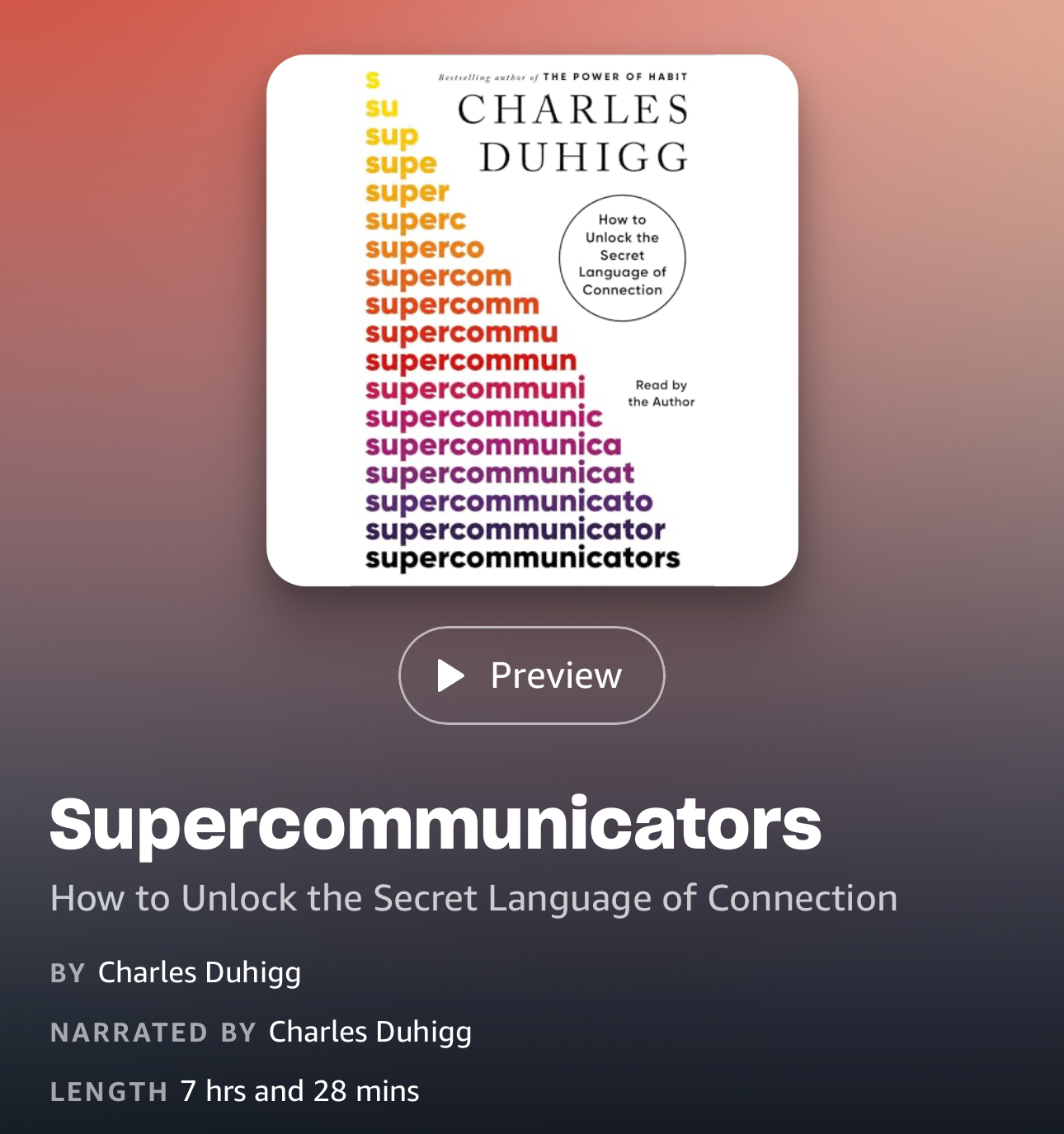
Supercommunicators: How to Unlock the Secret Language of Connection by Charles Duhigg
As a journalist, Duhigg does a stellar job weaving together fantastic stories with expert insights and research to offer lessons on communication. The heart of Supercommunicators is understanding and aligning to the type of conversation your communication partner is having. Duhigg argues that communication boils down to 3 types of conversations: practical (problem solving), emotional (seeking empathy), and social (relating to others). He suggests that communication often fails because parties are having different types of conversations—for example, your partner wants to vent and feel heard, but you go into suggesting solutions. There are also practical tips for improving communication, such as mirroring and looping for understanding.
This is a book I might come back to in print form, since I feel like I miss a lot of information and nuance in audio versions.


 Ever on & on