Waking up

I’ve never been a sleepwalker. I occasionally mutter things in my sleep, but I don’t wander around doing things of which I have no recollection.

Or at least that’s what I thought.

Then yesterday I woke up and found I was in the middle of something that I hadn’t even realized I was doing.

For months, I’ve been operating in survival mode – just getting things done, wondering how I was going to get it all done and when it would be over. I was riding out the storm, buffeted by waves, being pushed and pulled by the currents. I would call for help, and someone would throw me a line and tow me away from the most dangerous rocks amid churning sea. At least, that’s how it felt in those moments.

But then something I did yesterday awoke a new understanding of those days and months. I submitted my passport application. It should have been a perfectly ordinary task, mundane and bureaucratic. I took the forms and documentation to the local post office. I had my picture taken. I signed in the designated box. I wrote out a check to the State Department. I left with  a small thrill of excitement and anticipation of getting that little blue book in the mail and the opportunities it will open.

Then another reaction hit, one that’s difficult to fit so neatly into specific emotional boxes like “excitment” and “anticipation”. As I meandered to another part of the city to complete some other errands, I realized that I did this. There was this thing that I’ve wanted to do for a long time, that I wanted to do for me. A few months ago, I decided I was going to get it done this year. I pushed through all the things that needed to get done immediately, things that required time and money and emotional reserves – I found a new apartment, I moved, I filed for divorce… And then I did this thing for me. I had dreamed and planned; then I had the means and the freedom to follow through. Suddenly I understood that I had done this. Not just a simple passport application, but all of it – the things I needed to get done and the things I wanted to do. I had plans, and I executed them.

There was (and, in many regards, still is) a storm. But I did not simply abandon myself to its mercies. The waves crashed, the winds howled, the currents raged. But I did not quiescent. I acted. I did what was necessary to steer safely through to the horizon. I have had incredibly supportive people in my life, but I never surrendered control to them. They have been and continue to be invaluable, illuminating the way, helping me see that the storm will not go on forever, reminding me of my own capabilities and strengths. I have not gone through the experience alone, but I have made my own choices and, perhaps at times rather stubbornly, have done things on my own.

I find it amazingly easy to accept the burden of “failure” but often find it difficult to accept ownership of my accomplishments. This week, I ran up against stress and anxiety about basically everything – professional prospects, finances, social life, family demands, etc., etc. Some anxieties were legitimate, some habitual, and some simply irrational. In other words, I was a mess. In the midst of it, I had no sense of what I’ve achieved, despite someone reminding me. To then comprehend what I have done, to understand that I get to take credit for it, was overwhelming but important, as if I’m waking from the fog of a long sleep.

I am not caught in the currents, being pushed and pulled with no contol.

I am not being towed, leaving control to others.

I am making my own way. I am at the helm.

I get to take ownership of what I have accomplished.

And that is a very powerful feeling indeed.

Posted in Uncategorized | 10 Comments

Ramblings on life, change, and learning

Humans in my life are fond of analogies. I think it’s true of many humans in general. We try to take big, complex events and systems and shoehorn them into a model that seems less abstract to our minds.

Sometimes it works. More often, it breaks down very quickly.

My boss periodically comments, “This business isn’t a sprint. It’s a marathon.” He’s never run a marathon. I’ve run one in my life (so far). A marathon is in turn exciting, tedious, awesome, and grueling. You have to pace yourself early, so that there are reserves at the end. You have to take care of yourself and fuel along the way.

A marathon has a much more tangible outcome. You’re there to finish the race. Maybe you have a goal time. Maybe you’re trying to top your age category. But at the end of the day, you will know whether you achieved that goal or not. And all along the way, you will have people cheering you on. And on that day, you have one thing to focus on: running your race. It will be an intense day, but by the time you get there, you’ve been working at it for months, training for hours a week and (maybe) carefully attending to your health and nutrition. And for most people, all of the training goes on in the context of real life – jobs, families, friends.

———-

When I first started to write this post, I immediately started thinking of analogies – running, equilibrium, thermodynamics… Then I realized none of the analogies really work. In this instance, they only allow me to distance myself from that about which I write, to talk about things without being specific. But I think it’s time to come clean.

This time last year, there were trepidations but also high hopes for the year to come; anxious optimism might be a good term. But time, as it is wont to do, scattered intentions and plans into the wind. A new year brought massive change that left me operating in survival mode for the first 6 months of the year – the end of my marriage.

As you might imagine (or have experienced), even without the whys and wherefores, it is a grueling process on many levels. I started out the year living with my spouse in a suburb, commuting an hour to and from work each day. Then I was living there alone. Now I live in a flat that’s walking distance to work – with housemates. Not where I expected to be as I wrapped up my 30th year on Earth.

———-

There’s so much that has been hard, things I may or may not write about one day. For today, I’ll go back to the context of the earlier analogy. I’ve been far, far from peak production in the lab. The mental energy and physical time committed to dealing with logistics and the emotions of the process tore my focus elsewhere. On one occasion, my boss was checking in, asking if things had settled down. I was on edge already. No, I explained. They hadn’t settled down, and they wouldn’t for a while. I knew I had not been very productive or focused in the lab. And that really bothered me. But at the moment, I was just trying to get through. My boss pulled back. This wasn’t a push. Things had to be taken care of, he understood that. I voiced my own frustrations at my time and focus, and it was then he made the marathon analogy. He then told me he was invested in me as a scientist, and he would do what he could to support and advance me. He told me, as he had many times before, that he supported whatever I needed to do outside the lab. Because if things weren’t working outside the lab, it would be really difficult for things to work in the lab.

———-

I have many flaws. But one is particularly relevant to these ramblings, and one that I suspect is shared by more than a few of you. I am a driven individual, and typically I will expect more of myself than anyone else does. I think it’s a useful trait in science, but the other edge of the sword is that I have trouble cutting myself slack. I find it difficult to accept less than my best without descending into a spiral of doubt. I find it difficult to ask for help with things that I think I should be able to do on my own, that I probably would be able to do on my own in the absence of the added mentally, emotionally, and physically exhausting processes I’m going through. To me, this felt like admitting weakness.

But as much as this phase of my life has sucked, it’s deepened relationships and forged new ones. And, with no small amount of help from those people, it’s teaching me important lessons.

There is strength in admitting when you need help and asking for it.

There is courage is doing what needs to be done, even when it hurts like hell or is inexorably daunting.

And there is joy and happiness to be found even in dark times of life, and you have every right to embrace it – unapologetically.

Posted in Uncategorized | 18 Comments

#EB2013: Trashing the cystic fibrosis protein

Last year, I turned 30. It’s one of those numbers that often causes humans to pause and think about what we want to accomplish in the next decade of our lives – run a(nother) marathon, travel the world, land an awesome job… But how many of give much consideration to the question of if we’ll be around to celebrate that next decade? For patients with cystic fibrosis, an inherited disease that affects the lungs and other organs, that if is a big one – the median survival age for cystic fibrosis patients is 38.

Cystic fibrosis is an incredible example of a truly molecular disease. It’s caused by mutation of one gene encoding the cystic fibrosis transmembrane conductance regulator (CFTR), a protein that helps maintain salt homeostasis in epithelial cells. Epithelial cells line surfaces and cavities of our bodies, things like the airway, sweat glands, and ducts in the liver and pancreas; these cells stick close together to create barriers between different environments and maintain a careful balance of fluid and electrolyte shuttling between these environments. CFTR transports chloride and other anions into mucus lining the epithelium, and sodium and then water follow to maintain normal, fairly fluid mucus. If CFTR is dysfunctional, the balance breaks down; thick mucus builds up in passages of the airway and digestive system, which become blocked. The obstructions alone cause serious respiratory and gastrointestinal problems, but the thick mucus in the airway also creates a cozy home for bacteria, setting the stage for respiratory infections. The mucus and associated complications significantly impact quality of life, but it’s the infections that typically kill.

CFTR structure schematic

Schematic of CFTR structure from CFTR.Info

CFTR is a massive and complex protein, that must be properly folded, embedded in a membrane, and shuttled to the cell surface. The fully functional, or mature, form weighs in at almost 190,000 Daltons (g/mol for the chemists out there ;)), which is more than 3 times the size of a typical protein. It’s initially expressed as a smaller precursor protein (~135,000 Daltons), but as CFTR passes quality control checkpoints, it’s decorated with sugar chains that tell cellular machinery that this CFTR protein is OK and ready for the next step of the process. With normal CFTR, only about 30% of CFTR that’s expressed actually transits the checkpoints successfully. The remaining protein is trashed without ever having done the job it was made to do. Just as sugars flag proteins that have passed quality control, ubiquitin commonly flags proteins that need to be degraded. Ubiquitin is a small regulatory protein that can be attached to a specific group (lysine) on other proteins. Ubiquitin can be conjugated to itself to create poly-ubiquitin chains, which target the proteins to the proteasome, a large multi-protein cylinder that cuts proteins into smaller pieces, or to the lysosome, an acidic intracellular sack filled with degradative proteins; in both cases, the end result is destruction of ubiquitinated proteins. At  Experimental Biology 2013, Dr. Seakwoo Lee, a research fellow in Pam  Zeitlin’s lab at Johns Hopkins Children’s Center, presented work on how ubiquitin modifies and regulates CFTR stability.

Two ways to ubiquitinated protein degradation (source)

The Zeitlin lab worked with Michelle McClure in Eric Sorscher’s lab at the University of Alabama at Birmingham to use mass spectrometry (“mass spec” to its friends) to identify residues of CFTR that had been modified by ubiquitin used. CFTR was isolated from cells and chopped into smaller fragments; this process removes ubiquitin but leaves behind a trace of it (glycine-glycine) where the ubiquitin tag once resided. Mass spec defined the amino acid sequences of fragments and the locations of glycine-glycine modifications and thereby ubiquitin. Lee mutated each glycine-glycine tagged site to arginine, a substitution that maintains the charge of the protein but that cannot be modified by ubiquitin. For each mutant, he looked at the protein expression levels of total and mature CFTR. He determined whether ubiquitination of each lysine targeted CFTR to the proteasome or the lysosome by using small molecule inhibitors. Because CFTR only functions at the cell surface, Lee  checked surface expression of the mutant by confocal microscopy and Western blotting. Finally he checked the ability of mutants to modulate expression of the inflammatory chemokine interleukin-8 in an epithelial cell line.

They defined seven specific sites of modification, scattered throughout multiple domains of the protein. In all but one instance, lysine->arginine mutations increased the amount of total CFTR protein and, importantly, the amount of fully matured protein. Addition of ubiquitin to different CFTR domains targeted the protein to different pathways for destruction. Modification of the N-terminal and nucleotide-binding domains targeted CFTR to the lysosome, whereas modification of the regulatory domain targeted CFTR to the proteasome. Now you might think that more CFTR and more mature CFTR would also mean more CFTR on the cell surface where it’s needed to function. Yet mutants that prevented proteasomal degradation were actually expressed at lower levels than wild-type CFTR  on the cell surface, even though these mutations produced more mature CFTR  inside the cell. 

So Lee saw that CFTR expression was stabilized by introducing mutations that prevented ubiquitination, but he wanted to find out if it functioned properly. Previous studies had shown that CFTR surface expression and activity suppresses basal inflammatory signaling. In cultured epithelial cells, dysfunctional CFTR activates the transcription factor NFΚB, which goes to the nucleus and turns on genes associated with inflammation. Co-expression with functional CFTR counteracts this program. Lee used one of those inflammatory program genes (interleukin-8 or IL-8) to look at the functional outcomes of his CFTR mutations when co-expressed with a completely non-functional CFTR. Mutants expressed on the cell surface at levels approaching wild-type were non-inflammatory. With mutants that failed to localize to the surface, cells still produced

CFTR trafficking & degradation (source)

elevated IL-8. However, lysosomal inhibition increased surface expression of these mutants and decreased IL-8 synthesis. How did that happen? Lysosomes are tightly linked to endocytosis – that is, internalization of things bound to or embedded in the surface membrane. Like many surface receptors, CFTR is rapidly internalized and shuttled back to the surface (recycling) or shipped to the lysosome for degradation. Lysosomal inhibition ultimately piles up and inhibits endocytosis. Lee’s result might suggest that stabilizing CFTR expression alone is insufficient for boosting CFTR activity. Instead drug discovery and development might also need to CFTR internalization and recycling.

The FDA recently approved the first drug that actually treats the molecular cause of cystic fibrosis. However, this drug addresses only one aspect of CFTR dysfunction, its direct activity. Over a thousand mutations have been identified in cystic fibrosis patients, and mutations that alter CFTR stability and localization present more of a challenge for therapeutic targeting and will likely require a combination approaches. One day, researchers might be able to leverage the sites and roles of CFTR ubiquitination to develop a drug to enhance CFTR surface expression. However, Lee’s data are preliminary, and further studies are needed to confirm the mechanisms of ubiquitin regulation of CFTR. The Zeitlin lab also needs to identify small molecule modulators of the process and define the therapeutic benefit and limits of this approach. In the past few decades, the survival age of cystic fibrosis patients has increased dramatically, but there’s still a long way to go.


Posted in Uncategorized | 9 Comments

#EB2013: The Scientist-Advocate


Policy needs more science. Science needs more funding. Funding needs limited politically motivated restrictions. These are common refrains among the scientific community, but what do we need to do to get there?

On Saturday, the American Physiological Society hosted a session entitled “How to be a science advocate in your own backyard”, and the American Society of Biochemistry and Molecular Biology held a policy session, “How scientists can save the world”. Both societies fielded excellent panels of professionals engaged in science, science outreach, and science policy: for APS, Gina Schatteman (professor emeritus at UIowa, former AAAS policy fellow, and director of iExplore STEM), Tim Leshan (vice president for government relations at Northeastern University), Michele Sukup Jackson (PhD candidate and member of MIT Science Policy Initiative), and William Talman (professor at UIowa and former president of FASEB); for ASBMB, Tania Baker (professor and head of Department of Biology at MIT), Darlene Cavalier (founder of Science Cheerleader and SciStarter), and Craig Mello (professor at UMass Med and Nobel laureate).

I strongly believe that basic science holds the keys to the universe, and we have a responsibility to do important research and explain it to the world.

– Tania Baker

Advocacy can take many forms, from talking to your neighbor to coordinating with the White House Office of Science & Technology Policy. Schatteman divided advocacy into 2 categories: direct – working through official channels to affect policy, talking to your Congress representative; and indirect or “stealth”, being an advocate just by being a scientist and talking to people you know. Talking to your family and neighbors about what you do is a great way to get started. It’s a (mostly) non-threatening venue to practice talking about science to a non-science audience. Plus your family is kind of stuck listening to you but will also be honest about how you’re doing (Baker commented that your family will smack you if you’re doing a bad job :)). Next try a science festival; the presentations are short, and you have multiple chances to give it and modify it as necessary. Or maybe teach a science course for non-majors. Baker mentioned that her department is integrating communications into all parts of the science curriculum. Cavalier is leveraging Science Cheerleader and SciStarter to increase interest and investment of the public in science. In other words, opportunities to engage with non-scientists and promote science are all around us.

If we’re not passionate about keeping science going, we probably shouldn’t be doing it anyway.

– Bill Talman

However, direct advocacy – engaging with legislators – remains critical. Leshan put it nicely: “If you don’t advocate for what you care about, a million other people will be advocating for what they care about, and you will not be heard.” Talman encouraged scientists to not be “the typical NPR listener – all listen and no pay”. In science, we should pay our dues for the opportunity to do science by advocating for science. But approaching a Congressional representative might be an intimidating prospect for many scientists. Starting with local, “stealth” advocacy allows us to become comfortable discussing our science, but we must take a different approach to legislative advocacy. A few key points emerged:

  • Do your homework. Find out the representative’s record and stance on issues.
  • Hone your message. Have one or two key points.
  • Have a clear pitch. Your goal should be to inform legislators of your research and its importance, but there needs to be a clear ‘ask’.
  • Make evident how the issue affects the representative’s constituency and how you can help him or her with that issue. Talman recommended writing your areas of expertise on the back of your business card, so that staffers know with which issues you can help.
  • Learn how to present your message in a way that others will listen to it – especially when dealing with controversial topics. Schatteman provided herself, a stem cell biologist, as an example.  If she’s talking to someone she knows is a proponent for stem cell research, her approach is straightforward, easy; she can say “stem cell biologist” and know that she hasn’t shut down the discussion immediately. If someone has a record of voting against embryonic stem cell work, she emphasizes “adult stem cells”. Some people may immediate shut down at the mention of “stem cells”, so she starts with a target disease and implications.

If we based [science] policy on science, the world would be a different place. We base policy on emotions and politics.

– Gina Schatteman

  • Be flexible. Leshan shared an experience of a meeting in which the representative requested that the scientist end the meeting with a prayer. The scientists obliged and has maintained a strong connection with the representative.
  • Follow up and use multimedia to your advantage. For example, make sure that you have a webpage that includes a summary of your research and public engagement in terms that a non-scientist can understand.
  • Work with allies such as your institution’s government relations office or your professional society’s policy committee to coordinate efforts.
  • If you’re interested and willing, learn the ropes from the inside. Schatteman started off with her university conflict of interest committee; she progressed to first to the university’s and then to a professional society’s legislative affairs committee before spending a year as a AAAS policy fellow – this after she had established here independent research career.
  • Legislative advocacy cycles back to the public. The public – our our families, friends, and neighbors – help decide science policy by voting! Mello made the point that as long as the public doesn’t understand or even really care about science, “Congressional representation [of science] will be deficient”. We have to make the benefits of science clear.

If science is to continue to thrive, someone needs to advocate for it – and scientists must advocate for it. We don’t all need to be sitting in meetings on Capitol Hill. We don’t need to do all the advocacy. But we can each make a contribution to keep science and science policy moving forward

Further thoughts

Storify from APS Session

Storify from ASBMB Session

Posted in Uncategorized | 2 Comments

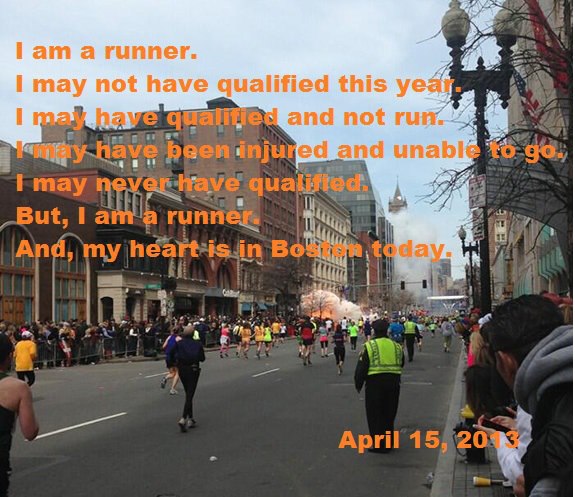
It should have been a beautiful day.

Sunny, a little cool, a bit breezy, but on the whole, not bad for spring in Boston. A fantastic day for a run.

I worked from home a bit before heading to the lab. A couple of hours after lunch, as is my typical routine, I headed to the gym. After about 45 minutes of strength training, I took off out the door, following one of my short loops to tack a couple of miles onto my workout. I passed people with their yellow bags and blue jackets, reminding me that it was Marathon Monday.

For my first four years in the city, I lived only a couple of blocks from a section of the route, and Paramed and I would walk up, watch with inspiration as the wheelchair division zipped by and with awe as the elite runner zoomed past. We’d meander down the last few miles of the course, cheering on runners and feeding on the energy and excitement of the crowd. Last summer, we moved into one of the more distant suburbs of Boston. I had briefly considered trekking downtown to spectate, but I had things to do, and there simply hadn’t seemed to be enough time of late.

I returned to the lab from my own, much shorter run. I grabbed a yogurt from the fridge. My boss wanted to talk briefly about a collaboration. We chatted briefly about another thing, I giving him a good-natured ribbing. I returned to my desk.

As I sat down, my phone vibrated with a text message vibration. Immediately it buzzed again. And then again. Messages from 3 different people, asking if I was in Boston, wanting to know if I was OK.

My stomach knotted. “I don’t know what’s going on, but something’s happened,” I commented to my labmate. I fired off one reply and started logging into my computer to find out what was going on.

My phone started vibrating again, a call this time from Paramed. When I picked up, I didn’t bother with pleasantries. “What is going on?”

“Where are you at? Are you OK?” he asked urgently.

“I’m at work. I just got back to my desk and had 3 different people asking if I was OK. What happened?” I asked.

As I asked, my labmate – having just gotten a text from her husband – answered. “Oh my god. There’s been some sort of explosion at the marathon.”

I thought I’d been punched in the gut. “Oh my god.”

At the same time, Paramed replied. “I wanted to be sure you were OK. There were two explosions at the marathon near the finish. I’m in class. We just heard about it.”

We exchanged a few more words. “I’m glad you’re OK. Please be careful,” he said before we hung up.

Stunned, I quickly began replying to the direct messages queueing up on Twitter, while pulling up the local newsfeed and checking Twitter. I fired off a text to my dad, knowing that my family would be hearing about this any minute. I assured my friends on Twitter that I was far from danger.

Then I called our other labmate. She’s a runner, a crazy runner, the kind who loves pushing through 26.2 miles and beyond. She had qualified and registered for Boston. But she’s also a new mom, and the time away from her daughter to train for a marathon was more than she was willing to give up, at the moment. So she’d decided not to run. But we had no idea where she was, whether she and her husband and adorable 5-month old daughter were somewhere along the course to watch.

The phone rang a few times, and she answered. “Belle, how could…?” Her voice cracked. She knew.

“Are you alright?”

Her voice steadied. “Yes. We were watching at Coolidge Corner [24 mi marker]. We’re almost home now.”

“Good,” I replied. “We weren’t sure if you were watching or where.”

“I just…” She took a breath. “First, who the fuck would do something like this? But second… if I had run, that’s about the time I would have been finishing. That’s my pace – 4 hours, starting at 10 o’clock.”

“I know.” I did know, and I didn’t know what else to say.

“My sister’s best friend is running, and she would have been in the same group. I hope she’s OK,” she continued. [Later she learned that the friend was fine; she’d finished 10 minutes before the blasts.]

“I hope she’s OK,” I replied. “I’m going to get off, free up a ‘line’. I’m sure everyone’s trying to get through, but I wanted to make sure you were fine.”

“Thanks,” she said. “This just hits close to home. I’m hugging my daughter tight right now.”

Then I returned to the coverage. I watched and listened, my brain numb. By the time I tuned in, the anchors were still being cautious, indicating that there was no information as to whether it was intentional or not. But watching the video, I knew in my gut it was. Some part of my brain tried to come up with an alternative but was quickly shut down. Later they reported that, asked whether the blasts were bombs, a law enforcement official responded, “Hell yes. What else could they be?” As the coverage continued, it became evident no one thought this was accident. It was also clear, unsurprisingly, this story was personal. One anchor commented, “I’m infuriated. I hope they get this SOB in a hurry.” In the confused tumble of emotion, this stuck with me.

And yet through all this, the sun kept shining. It didn’t seem right. No, that wasn’t it. It didn’t seem real. It seemed like something out of a movie. Where was the dimming of the light to set the mood?

After the Boston PD press conference, I packed up to head home, wondering how long it would take me. The bus ride was strangely silent, no one daring to speak a word. Terrible things happen all the time – a bombing, a shooting, a fire – but somehow it seemed more acute, because it happened in our city. More than that on a day that we celebrate human commitment, motivation, discipline, achievement, and joy in what is normally a very solitary activity.

We all disembarked at the train station, murmuring farewells to the driver. At the entrance to the train station, I discovered a full security check – bag searches and metal detectors. And yet, despite the hundred or so people waiting to get to their trains, there wasn’t a word of dissent or complaint or protests of missing a train. As the train pulled out of the station, I watched a helicopter hover over the city. It should have been there for the finale of a marathon; knowing it was there covering the aftermath of an attack was chilling.

IMG464

I now sit at home, sipping a beer and processing this day. The seemingly overwhelming problems of yesterday seem rather small. The worries I had have been temporarily displaced by shock and staggering sadness. There is no sense to be made of this. It was a horrific act. It’s the sort of thing we want to believe is inconceivable – and yet we know from recent history it is not. Innocent people have been killed, and many, many others injured. It took only a few moments on a Monday afternoon to completely change how we viewed the world. Suddenly every neglected bag, opaque water bottle, or abandoned box had become a threat. But even as objects were eyed with suspicion, there was also a great outpouring of aid and compassion for people.

This city and this event are irrevocably changed…

Changed… but not defeated. There’s far too much spunk in this city for that.

644490_10151402092011958_743569778_n

via Facebook

Posted on by biochembelle | 3 Comments