Understanding—and modifying—”standards”

“The work isn’t up to the standard.”

But what precisely is the “standard”? For most professional outputs, there are layers.

Requirements

Requirements are the base and the easiest layer to understand—even when they don’t make sense.

These are the parameters you need to follow to keep from getting your work kicked back immediately. Think page limits and format constraints for a grant application or manuscript submission. Requirements will (or at least should) be clearly documented—written down and posted somewhere the relevant parties can find them.

Requirements are sometimes tedious and seemingly pointless, but you follow them anyway because they’re required. Occasionally I’ll see an academic (typically a senior man) say he pays no mind to journal requirements and submits the document formatted to his liking. Maybe that’s true, and he gets away with it. Ultimately my opinion is: Ignore requirements at your own peril.

Implicit Rules

Me nem nesa. It is known.

Implicit “rules” are the guidelines that nearly everyone seems to follow even though there’s probably no or little documentation. Some will feel like intuition or common sense to many, like using a formal tone in reports. They’re in part embedded in education and training. Other elements you learn on the job. And sometimes you can just google it.

These standards and norms are the widely(?) accepted/acknowledged expectations for how things look and feel. Some of this varies with the product. You’re not going to expect the same level of refinement from meeting minutes or a quick email to a peer as you do from a grant proposal or a report to executive leadership. Expectations will also vary by field, sector, and even organization.

The problem with implicit rules, of course, is that they’re implicit. They’re not written down, and any one person’s knowledge and understanding of them are going to depend on their own path, experience, and past and present. Yet many people don’t realize the difference between “this is how it’s done” and “this is how it’s done here.” Failure to adhere to such norms can secure one labels such as “sloppy” or “unprofessional”. Unknown hidden norms can also hold people back in their careers, for example, apparently taking too much or too little credit for their contribution to a project

Norms are part of professional culture. They can be useful, by establishing typical approaches to communication or interaction that can help us get to the same place faster. But I think often we underestimate how universal the implicit rules are and sometimes overindex on adherence to them for no good reason.

Preference

Is it wrong, or is it just not “mine”?

This is, for me at least, the most challenging. We each have our own way of doing things. And when you’ve been at it for a while, you can begin to internalize your way as “the” way. Your preference can become the standard that you expect from others, and every other way is “wrong.” Or if not wrong, less good.

Of course your way is what you’re used to. You might have reasonable justifications for some elements—this is how we make clear that we’re meeting requirements, that expedites review by the project lead. But sometimes your way is simply what you like, and it might not even be the best way for your audience, colleagues, or clients. But if you view your way as the standard, then you may miss out on other ways of approaching and potentially improving the work.

Managing the layers of “the standard”

The problem with “the standard” mirrors other issues in the workplace (and the world). The standard is rarely enforced equally, and it’s disproportionately used against those in groups that have been historically marginalized in the workplace. What we can do about “the standard” depends on how much power we have and the risks we’re able/willing to take.

Here’s my general strategy:

Requirements: Follow them.

There may be occasions to advocate for an exception or change, usually through very specific channels or mechanisms. Federal funders, for example, solicit feedback on proposed changes and policy implementation. If you have a group (e.g., a professional society or center) to work with, all the better.

Implicit rules: Learn them. Understand them.

If you’re a manager or established contributor, communicate them. Take the guesswork out as you can. Offer the rationale. Ask yourself, “How important is it?” In digging into the what and why, you might find that there’s a better way to do it and that you have the authority or influence to change it.

Preference: Examine your inclination to change it.

Maybe you have a preference that makes it easier for you to pull information. Maybe you need to make many voices sound as one, and you’re the one who gets to decide what that sound will be.

But if the work is clear, complete, and accurate, if it’s appropriately suited to its audience, maybe it’s time to let go of how you would do it and leave space for others to develop their voice and style.

Posted in Uncategorized | Leave a comment

Companion not foe

I felt the unease and heaviness in my body from the start of the day. I just wasn’t quite sure what it was. Anxiety about work? Or the world? Irritation about a situation? Or with myself?

I did something unusual for me. I didn’t try to push it away. I just let it be. I felt waves of frustration that it had intruded on my day, but it carried the weight of something important. So I waited.

Eventually it moved from shadow to light. This was grief. Unbidden, unexpected. You see, I lost my father last April. I moved through the experience, feeling my reactions were somewhat muted for such a life changing loss. But this was the second time I’d lost a parent. I knew that grief moves in its own way and time.

And now here it is. No special anniversary, no precipitating event, that one might want to share with a parent. Just everyday life. A few days ago, on a run, I saw someone from a distance who looked like my dad. Not the image that comes to mind when I think of him, but as he was in the last couple of years. I don’t recall having that experience after my mom’s death. My breath caught. I had to pause, to look out across the water, back turned until this stranger passed.

Was it that single moment that triggered this wave of grief? Or was it grief in the shadows that made me attuned to the similarities of this passerby?

Often I hear us (myself included) speak of grief as a force—hitting us, crashing into us, overwhelming us. In this frame, it’s water, an ocean—uncontrollable, untamable. Threatening to pull us under, drown us, if we can’t escape to the shallows or the shore.

But what if grief is something else entirely? What if it’s that still, small voice trying to bring something important into view?

Yesterday afternoon, as I had pieced together the identity and source of my emotion, I had a preplanned meeting with a peer mentor. My wont is to compartmentalize the personal and the professional, despite knowing how much each can affect the other. But I chose, at my mentor’s invitation, to share more about what was going on. He reminded me that feelings arise from somewhere. They’re calling our attention, maybe for a reason, and maybe we should take a moment (or a few) to be with the emotion and see where it’s pointing.

Early this morning, a part of me wanted to just retreat back into sleep. But another part called me forward to my movement practice. A bit out of character, I felt the need for something that specific for this moment and quickly found that session: yoga for grief. It was a gentle practice, staying close to the ground, bringing focus to breath and the heart space. Today I felt the connection of this practice to my inner stay profoundly. The session progressed then settled into child’s pose. Oh the beautiful resonance that an insight about grief for my father should come at this point. As my forehead rested on the earth, a concrete thought emerged from the abstract emotion: The people who always held unconditional for you are gone. Can you ever be enough for those who remain?

This surprised me. I’d never felt or thought this, at least not so clearly, before. But I knew instantly this wasn’t extracted from overthinking. It had come to mind effortlessly. This had been sitting somewhere deep inside my psyche, unrecognized.

But then an inner voice asked: Is that true?

I understand immediately that it was not. I brought to mind my partner, my brother, dear friends. I know I am enough, as I am. Perhaps this fear comes from the worry and stress of proving myself in different arenas of my life. But I am not alone, and I am enough.

As I completed my practice and put things away, I thought of how we talk of sitting with grief. I am one who needs to move—I thought, at first, through grief, but then saw it’s moving with grief.

I return to this idea that we so often view grief as something to stand against, to endure, to wait out. But maybe there’s another way. What if grief isn’t an enemy, a foe to reckon with? What if grief is a companion, a guide? Not one we invite in, but one that is there at the necessary time, even when we’re not consciously aware of the need. After all, it is within us, a part of us, and to fight against it, to disdain it, is to turn against ourselves. That’s not to say we ought to keep grief close, cling to it. Grief can be heavy and uncomfortable and painful. But maybe we don’t need to shun it when it comes. Because it helps us cope with the hard certainty that someone or something is gone. And it can shine a light on lies and truths we need to see.

Posted in Uncategorized | Leave a comment

Books I read in November & December 2024

This edition of What I Read covers two months—in part because I only finished one book in November, even though I read a lot! But I had conference travel, then vacation in November, and I can only take so many books when I travel (yes, I’m a Luddite who prefers physical books). Some books were ‘paused’, others picked up and finished off that had been lingering a while.

The Vacation Reads

I went with soft cover/paper back for our trip to New Zealand. We were away for 2-1/2 weeks, so I was in danger of running out of reading and picked up a couple of new reads in fabulous local book shops.

Brief Flashings in the Phenomenal World by Katie Arnold

I left this one behind in a little lending library in Wanaka because it was such a fantastic read. It’s part memoir, part Zen philosophy. Katie Arnold is an ultrarunner and writer. This book centers on a whitewater rafting adventure that goes awry—when Katie breaks her leg just a couple of miles in but continues the almost weeklong journey anyway. It jumps around in time, covering life & sport, being in relationship with others, loss & recovery. If you’re an adventurer, an athlete, or just someone who’s dealing with the unexpected in life, check it out.

Four Thousand Weeks: Time Management for Mortals: Time Management for Mortals by Oliver Burkeman

I’d resisted picking this book up for 3 years. I’m not quite sure why, because several thoughtful people (both public podcasters/writers & friends) raved about about it. I think I saw it as a time management book & felt like I didn’t need/want that. But then Burkeman was making the rounds for his latest book & his perspectives resonated. So I decided to dive into 4000 Weeks. I found that it was so much more than a “time management” book. It’s history & philosophy & anthropology, leading not to a slate of tactics to be more “productive” but an invitation to see & experience time in a different way. It’s the anti-time management productivity book.

Rules for the Dance: A Handbook for Writing and Reading Metrical Verse by Mary Oliver

Earlier this year, I decided I wanted to bring more poetry into my reading. Mary Oliver was a name that frequently popped up. So I was delighted to find her book that provides a grounding and analysis of elements of metered poetry. I’ll never remember all the terms, but it lends a greater appreciation of what it takes to write good poetry. And Oliver’s prose is as beautiful as her verse. The second half of the book is a wide ranging anthology of metrical poems.

Twelve Moons by Mary Oliver

Continuing the theme of reading more poetry, I’d also picked up one of Oliver’s collections. All grounded in nature, some were playful, others filled with wonder, and some simply gut wrenching. Raccoons was perhaps my favorite.

We Will Not Cancel Us: And Other Dreams of Transformative Justice: Breaking the Cycle of Harm by adrienne maree brown

amb has been a leader in social movements & writes elegantly & compellingly about imagining & cultivating different ways of being in relationship with others, our systems, our worlds. She released this short set of essays, building on a blog post published in 2020. It’s a thoughtful exploration of what happens in the wake of callouts, particularly in the online era.

The Whale Rider by Witi Ihimaera

I don’t read lead a lot of fiction these days, but my god, this was blow-me-down good. It’s a classic work of Kiwi literature that I picked up on our last day in Auckland. First published in 1987, Ihimaera weaves together a story of Māori culture & legend, of leaving & returning home, of racism & patriarchy, of generations & family conflict, of preserving culture & environment in a rapidly changing world. All this through a tale of a young girl finding her power told by an older uncle growing up in a different way. A stunningly beautiful piece of magical realism. It took me less than a day to read it, just couldn’t put it down.

Silence in the Age of Noise: In the Age of Noise by Erling Kagge

Imagine walking across a frozen expanse, for weeks, with nothing but your own thoughts for company. Kagge, an eclectic explorer, chose this path on his trek across Antarctica—-and it drives this series of meditations on the noise of the world & our struggle to go inward & be with ourselves. Essays interwoven with art, it’s another quick read, but broken into brief pieces so you could easily approach it as a short daily read if preferred. I found this one at The Next Chapter, an absolutely delightful bookstore in Wanaka.

The Next Chapter, Wanaka. You can stand at one end and see the entirety of the store, but it’s packed floor to ceiling with wonderful finds—primarily curated based on what thrills the owners, staff & patrons. I could’ve spent a whole day here.

The pre/post-vacation reads

I started the first couple of these before travel, but they were a bit heavy (figuratively/literally) for vacation. So here we’re back to our regularly scheduled programming, so to speak.

Mistakes Were Made (but Not by Me) Third Edition: Why We Justify Foolish Beliefs, Bad Decisions, and Hurtful Acts: Why We Justify Foolish Beliefs, Bad Decisions, and Hurtful Acts by Carol Tavris, Elliot Aronson

This is a deep dive into understanding dissonance reduction, why & how humans mitigate the identity threat of errors, mistakes, actions misaligned with our values. It looks at why self-correction & admission of mistakes is so difficult. I’ll admit, there were times the book felt a bit repetitive, as it illustrated its point across different domains, but I think the repetition was valuable in illustrating the impact of these failures at individuals, social & societal levels. It ends on a tough note—the final chapter, added in the third edition, about democracy & demagogues was written in Dec 2019, so it felt heavy after the 2024 election.

The book ultimately offers some hope in examples of people who broke free of the self-justification cycle & made significant course corrections. In short, evidence isn’t going to save us. It takes connection & curiosity, the very things we seem to be withdrawing from at a societal level.

10 to 25: The Science of Motivating Young People: A Groundbreaking Approach to Leading the Next Generation for Managers, Parents, and Educators by David Yeager

What does it take to get youth & young adults to make “good” decisions & strive for excellence? This is the central question, a focus of Yeager’s psychology research. The premise is that we’ve historically viewed this age group as incapable of making choices that are good/healthy in the long run because their brains are awash in hormones & not fully developed. Yeager argues for a different model: that 10 to 25 year olds are trying to find their place in their tribe(s) & are striving for status. He establishes the concept of the “mentor mindset”, setting high standards for young people but also providing high support to encourage striving & achieve competence in their endeavors.

Similar to the one above, this book began to feel a bit repetitive at times. I think it’s a trap/feature of many books written by academics for broad audiences. They succeed in making the content accessible but, in covering extensive evidence, are replaying variations on a theme. (I get it, because I can fall into this trap too.) A major plus of this book is highlighting a few simple interventions that can have significant effects on shifting behaviors in this group, such as the feedback note that states you’re giving the feedback because you believe they’re capable of attaining high standards. And some of the lessons for the younger age group can, I think, also support older groups too.

Overall I think this is a good read for those teaching, mentoring, or managing younger folks.

The Universe in Verse by Maria Popova

This is a lovely anthology of poetry, each work paired with art and a short essay about the wonder of the world and science. It’s about the people behind the science and the poetry, as much as the science itself. Pick this up if you need little doses of awe and delight.

Glad We Met: The Art and Science of 1:1 Meetings by Steven G. Rogelberg

Rogelberg is an organization psychologist known for his research on meetings. The book, though, could’ve used an(other) editorial pass—there were a few obvious errors that I found distracting as I read. But the content was interesting & useful. This book focuses almost exclusively on 1:1 meetings between managers and their direct reports. It first presents the case for 1:1s & how they can improve employee engagement. Then it goes into strategies for creating connection & value in these meetings, starting with a focus on the reports’ needs. There are lots of great tips & tools, some of which I’ll be bringing into my existing 1:1s.

Posted in Uncategorized | Leave a comment

2025: a year to trust

The year ahead has been looming large on my mind for many months. You can see that reflected even as I wrote about my theme for 2024.

This year, I am leading a large, complex project at work. In fact, the work started with a small core group a year ago. But soon it reaches full swing.

Flash back & forward

The last time I managed such a large project was my first go, in a new leadership role focused on this work. The work of many people, it would determine whether we continued to receive funding for our institute. Oh, and it was 2020. We had to transition to working from home. I had to hire and onboard my first direct report over Zoom and phone. Many of our contributors were physicians, treating patients in a pandemic. In December of 2020, I started my days on the laptop with coffee in hand, and I ended my days at my home desk, with an empty glass of wine at hand—often having eaten dinner, which my husband had made, at that same desk. There was very little running in the final months of the year. My stress and anxiety were high. My relationships were a bit strained. The year had drained me.

This year, we’re applying for our major funding again. This time, the funder has changed the structure and shifted focus. We have new leadership. I have broader responsibilities within the institute. But I can’t have the year I had in 2020. It was damaging to my physical, emotional, and relational well-being.

Something to lead 2025

As I sought a beacon for 2025, I thought about sustainable excellence. But that seemed to place the focus solely on my professional identity. I played with words around wayfinding, like North Star and compass and navigator or guide. But they felt too abstract and/or passive. Recent reading had me thinking about resilience. But that felt too focused on the stress, activating practices, many of which I already have. And it missed the exhilaration that accompanies work that matters and that you (sometimes) excel at. I then considered adaptation and Brad Stulberg’s concept of rugged flexibility. But somehow these felt too focused on changes, not adequately recognizing the foundations and experience that I didn’t have 5 years ago.

Finally, though, as I looked back over the lessons I (re)learned in 2024, a word glowed brightly. It hummed resonantly within me. I carried it with me a couple of days, and it took root in my heart and mind.

Trust (v.)

I have held high standards for a longtime. I have fallen into perfectionistic tendencies. I have doubted myself, my capabilities. I have even doubted others’ assessment of and faith in my skills and abilities. I have hauled around a lot worry and anxiety. I have taken on work that maybe shouldn’t have been mine, perhaps because I couldn’t let go of my expectations or because I felt it was my role to protect others.

Yet when I returned to my monthly reflections from the past year, I saw something I might have missed before. I saw strength. I saw recognition of skills that I’ve built over a lifetime. I saw acknowledgement of growth and change, even as I knew there was space for improvement (as there always is). I saw reminders to trust.

Trust is not a static thing. It is tended by ongoing engagement, though often in the background. We can say we have trust (n.) in something or someone. But its real value comes in the practice. We put our trust on the hook when we trust (v.) that capability or person and entrust (v.) it/them with the work at hand.

This image offers an example of what’s possible when we trust. It was taken by a friend at mile 70 of a 100-mile race. I had to trust my training, my friends who paced and crewed me, the many lessons I’ve accumulated over 5+ years of ultrarunning. It was an incredibly challenging thing, exhausting, and yet there was so much beauty in it too.

And so 2025 is my year to trust (v.)—not just to recognize skills, commitment, and accountability in myself and others, but to rely on them in the year ahead. A few specific areas where I can practice trust have emerged:

  • Trust the training. This comes from my running practice. It’s about managing the nerves as you approach a big goal race. Know that you have done and are doing what you need to do—and that “cramming” in extra miles or workouts probably won’t help. It’s about the illusion of control, that more must be better. I want to bring this idea into other parts of my life. I want to trust that the experience I have, the work I have done and will do, is creating the conditions for success with sanity.
  • Trust my intuition. I trained as a scientist. I can be incredibly analytical. And yet I often look back on a situation and see that the analytical side slowly arrived at the same end as my intuition. That doesn’t mean I should skip or ignore the analysis, but rather to not so readily dismiss instinct.
  • Trust my people. This applies to my team, my leaders, my partner, my friends… I’m not in this life alone. We’ve chosen these relationships. I know what they can bring into my life, how they can help and support me—if I let them, if I get out of their way.
  • Trust my wisdom. I typically think of wisdom as something that we learn from others. As I reviewed those lessons I wrote down from each month of 2024, I was moved and struck by how some cycled through the year in different ways. This isn’t about ego. I know I have so much to learn in life. But I’ve been on this planet for more than 4 decades now, and I can honor what I’ve learned along the way.
Posted in Uncategorized | Tagged , , | Leave a comment

Looking back: how the year for systems went

In 2024, my word of the year* (sparked by Ryan Holiday) was systems.

“You do not rise to the level of your goals. You fall to the level of your systems.” – James Clear

This quote is on a post-it by my desk. I keep coming back to it as a reminder for the importance of systems in moving through the world, including how systems can block us from achieving goals.

I approached systems on different levels in 2024. I started with my personal organization. I’ve tried different approaches to task lists and time management. The everything list inevitably led to frustration and overwhelm. Starting with Ugmonk Analog and adding in Smartsheet for all task tracking, I developed a system to manage the cognitive load of numerous projects and activities to follow and to set a reasonable/achievable amount of work for the day (mostly). I integrated into my daily and weekly planning work an iterative reflective practice that has helped me recognize my reactions and responses and to see trends in what I’m experiencing. This in part adopts Cal Newport’s ‘shutdown routine’ (see my post on shutdown practices).

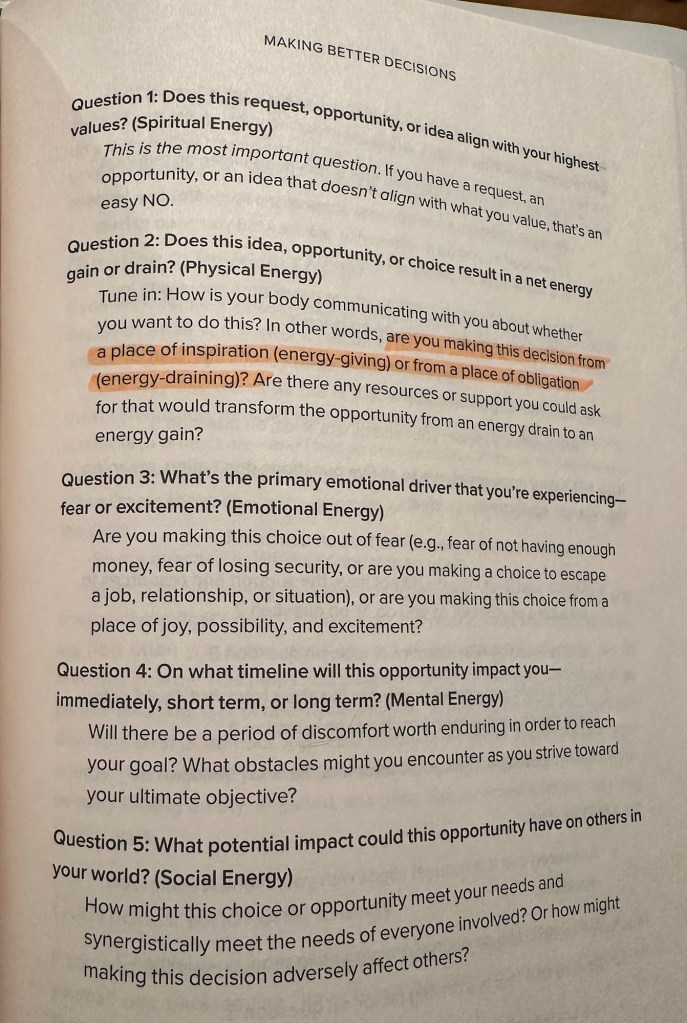
These systems helped me not just spot but act on challenges I’ve long experienced around taking on too much work personally. One new ‘system’ I added was a 24-hour rule for new projects. If it’s an obvious ‘no’, I can say so immediately. But if I’m considering a ‘yes’, then I have to take at least 24 hours to respond. I need to check if I have adequate information to make a decision and consider the impact on my work/life. What will need to change if I say ‘yes’?

I also tended relationships and tried new processes as the system of our institute shifts with changes in leadership and future expectations set by our funder. I started figuring out the levers I have to help me address challenges as they arise, that I don’t have to do it all alone. I worked towards more shared systems for my team, as it grew this year. There’s still space for developing shared practices and systems, but I’m further along than a year ago.

Outside work, I also worked to shore up leadership of a women’s trail running group I co-lead. These voluntary roles can take a lot of energy. Having a team means each of us can step forward or back as life cycles through its seasons and demands.

I continued to fuel my physical training, literally and figuratively. That was my coach, my community, my commitment. They supported me through finishing one of the toughest 100 mile foot races in the United States.

I found that some of my systems were already thriving through routines. Early mornings for yoga—though in 100-mile peak training, sometimes yoga was a 30-minute nap, thanks to learning to listen to the signals of my body systems. A bit of time for reading everyday—culminating in 39 books read. A farm box delivery for half the year to promote consumption of nutritious fresh vegetables from the region. Using Sunday dinners as a time to check in with my partner at the table.

I can always find ways that I fell short. But overall I can see the progress I made on crafting systems that support me. I feel more prepared for the year ahead than I did a year ago.

* I first selected a word/theme for the year in 2018. You can read about the origin of this approach and the first theme here.

Posted in Uncategorized | Leave a comment