
What’s the point (of the Ph.D.)?

A fancy degree. A hefty book. If you’re lucky, a few journal articles under your name. And the title of “Doctor”. These are probably the most tangible deliverables of a Ph.D. in the sciences.

We talk about how Ph.D. programs and postdoctoral positions are “training phases”, preparing us for… science… and stuff. But for what exactly are these programs training us?

Some will say that Ph.D. and postdoc training are designed to prepare you to be a career in science and, more specifically, a career as principal investigator. If that’s the case, and given that 80% of Ph.D. recipients will not be on that career path 10 years after earning their degrees (see pg. 25 of NIH Biomedical Workforce Working Group Report), then programs are missing the mark by failing to train the vast majority of their wards for jobs they actually choose pursue.

But frankly, I don’t think the point of science training is, or really has ever been, to create a bunch of head lab honchos. The point is to train people to do science. That’s it. A Ph.D. program is meant to lay the foundation for a field of study, to teach concepts and theories, to develop critical thinking and analytical skills. When you finish a Ph.D., you should be able to form a hypothesis, design an experiment, analyze the data, and communicate the results to peers. Actually, I think NIGMS has a pretty good vision in its Strategic Plan for Biomedical and Behavioral Research Training, which outlines:

“… after training, well-prepared students:

  • are curious, intelligent and creative;
  • are critical, rational thinkers, capable of organizing and analyzing data;
  • have a deep knowledge in a specific field but are conversant in related fields;
  • are able to formulate significant, testable scientific questions and are technically proficient;
  • have the capacity to listen effectively as well as to write and speak cogently;
  • are tolerant of ambiguity and resilient in the face of setbacks;
  • are able to work effectively with people who have different perspectives, priorities or intellectual approaches; and
  • know and follow the standards, responsibilities and culture of the scientific community.”

That’s what you should get out of a Ph.D., and those are the training goals funding agencies should be concerned about. These elements are useful and important for any career track. Yet they’re not specific to any one career track.

So we say we need to do more to prepare young scientists for careers, especially for careers outside of academia. But what exactly do we need to do? How do you introduce additional training without detracting from the primary goals of a Ph.D.? How do you provide the variety of training required to cover myriad career paths? Or another way, how do you give someone skills s/he will need without burdening hir with unnecessary or irrelevant training? How do we move from crucial but rather soft training goals to preparing for actual careers? And what roles should each member – programs, PIs, trainees, funding agencies – play?

Tomorrow I’ll post a scheme floating in my brain, but in the meantime, leave your thoughts in the comments.

By the way, if you’re a grad student and think you have a good idea with “potential to improve STEM graduate education and professional development”, check out the National Science Foundation Graduate Education Challenge. You could pick up a cash prize for a 1000 words.
Posted in biomedical workforce, graduate school | 8 Comments

Science, the human endeavor

From astrophysics to microbiology to behavioral science, one common thread runs through all research – the human element.

Science is an intrinsically human endeavor. It takes human curiosity to ask the questions, human logic to design the experiments, human ingenuity to incorporate the results into an evolving model. Despite tropes portraying science as a purely logical enterprise executed by cold automatons, it is wonderfully, woefully, beautifully, messily human.

Yet sometimes it feels as though we’re expected to be both more and less than human. More in that we need to work longer hours at higher efficiency, through health and illness. More research, more papers, more grants – sleep is for the weak! Less in that we should not allow little things like stress and emotions and events outside the lab to influence our pace and focus. Chop, chop, no time for distractions – science waits for no human!

Sometimes the pressure to be more and less than human comes from external sources – those above us in rank or, more often in my experience, those at our own level. But much of the pressure to perform is internal. We see funding woes and dire job prospects and competitors’ papers, or maybe we just see an unanswered question, one that we know we can resolve if only we work hard enough. We dial up the pressure to be “better”. That compulsion drives us and can be a constructive force. We also use it to build unreasonable expectations we set for ourselves.

Sometimes we try to keep our lives outside the lab compartmentalized, to keep it from interfering with our work. But you know how we’re fond of saying that science isn’t 9-to-5? Well, life isn’t 5-to-9. It isn’t so easily contained, packed into a box and placed onto a shelf, to be taken down at a less disruptive time. We must take care of ourselves and the lives we have – lives that bring change and crises and good fortunes that demand our time, focus, and attention.

There are times in life we need to let up on the pressure we place on ourselves. If we’re really lucky (or choose very wisely), then we surround ourselves with people who help us accomplish that. We circulate the stories of the departments and supervisors who set forth maniacal models of how science should be done. We perpetuate illusions of the excessive standards of Real Hardcore Scientists(TM). Do these people and places really exist? Sure. But there are also real scientists doing good work who believe it’s important to have a full life, who do not expect themselves or anyone else to place elements of their lives in suspended animation for the sake of science.

Science demands that we work hard, but our lives demand, on occasion, that we cut ourselves some slack. Science has always been and, unless we are one day converted into cyborgs, shall ever remain a human endeavor, complete with all its humany wumany madness. And in spite of this (or perhaps with its aid), science has marched forward and shall continue to do so with mere humans making the way.

Posted in attitudes, balance, for the love of science, productivity | 6 Comments

Fitness of body and mind and #50APs

A recurring topic for many of us (and by “us”, I mean scientists & non-scientists alike) is taking the time to take care of ourselves. Sometimes it involves calling it a day in spite of the dozen other things we need to get done. Other times, it’s about daily practices to keep us healthy.

Lately I’ve been dealing with some major stress of the unbloggable kind; such is life. Of course, as fate/luck/coincidence would have it, this comes at a time when I have more than the usual amount of stuff on my plate at work, stuff that requires focus and attention, which can prove difficult when distracted and stressed out. I’ve been through enough stressful occurrences to know that I can easily fall into cycle of letting stress squeeze out those things which make it easier for me to deal with the stress (kind of ironic, isn’t it?).

So, especially since returning from the holiday break, I’m trying to be particularly vigilant in staying out of that cycle. I’m keeping up my food journal and sticking pretty closely to a meal plan. Almost every meal for the week comes from my kitchen, and on the occasion that I do get takeout, I’m mindful of my selections. (That being said, sometimes you need a cheat meal, and last night’s BBQ chicken pizza was heavenly, even if it did come from the freezer section at the grocery store.) I’m limiting my alcohol intake. I’m trying to keep a consistent sleep and work schedule, making an effort to catch the same early train even when I really don’t want to drag my ass out of bed (which can be difficult when it’s 3 friggin’ degrees Fahrenheit outside). I’m also trying to maintain a good level of physical activity.

It’s the last one that can be the hardest to keep up, the one that carries an element of guilt, especially when there’s much to do in the lab, because it actually takes time out of the day. Having a gym across the street helps, and I often try to plan my workout time around long incubations for experiments and take less time for lunch. It also helps that my boss considers maintaining non-science domains of one’s life as an essential part of being a productive scientist. Even so the motivation to work up a sweat can wax and wane. Two weeks ago was great but last week, not so much.

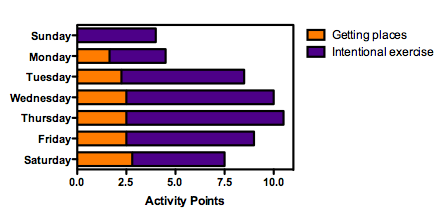
Sometimes, though, a little external motivation can serve as an excellent catalyst. Last weekend, Dr. Isis issued a challenge to earn 50 activity points in one week. One activity point is earned for every 80 calories burned… So that’s an extra 4000 calories in 7 days. I decided to take up Isis’s challenge. I typically walk to and from my apartment to the train, but this week I added a walk from the train to work, when I would usually take the bus. I also bypassed the elevator and took the stairs more this week. These activities to get places I was already going amounted to just over 14 APs for the week. Some days I added an extra 10 or 20 minutes of cardio to pick up an extra AP or two. My workouts – ranging from a couple of miles outside to a couple of hours in the gym (the full breakdown collected here) – accumulated almost 40 APs. I ended the week with 54 APs.

Activity points from the week of January 20th

Activity points from the week of January 20th

I also ended up with the first consistent week of running I’ve had in ages – 4 days for 11.5 miles. And I pushed myself hard enough to clear some headspace, even if for a short time, and to a point that made it easier to sleep at night.

Today I’ll be taking a day of rest, after 8 straight days of feeling the burn. But tomorrow I’ll be back in the gym, for the sake of body and mind.

Oh, and thanks for the extra nudge this week, Isis!

Posted in balance, motivation, nonscience, postdoc life | 1 Comment

Creation

Somewhere in the recesses of my mind, I recall a myth of a creature waiting to devour a child just as the mother gave birth. Or maybe it was the plot line of an episode of Angel.

No matter.

In recent months, I’ve been considering the future of my research project – as in its future outside the walls and support of my postdoc lab. The very thought is both exhilarating and terrifying.

A metaphor for (but with less death and destruction than)  the creative process

A metaphor for (but with less death and destruction than) my creative process

Early in the process, I found myself coming up with ideas, only to immediately shoot them down as stupid, trivial, unfeasible … You get the point. A creature in my mind, that ever present critic, was devouring the children before they even had a chance to breathe, before there was time to see what they would become. Frankly, it was demoralizing, because it quickly fed the flames of that ancient dragon of doubt. “If I can’t even come up with one good idea for this project, what chance do I have of success in this field?”

In my first year or so of grad school, Bear (my PhD mentor) had a chat with the new additions to the group, sharing his perspective of what it takes to succeed in science and how to get that out of our time there. Among his advice was this snippet:

To have good ideas, you need to have many ideas.

Those words replayed in my head recently as I struggled with defining a vision of my future work. I realized that I had mostly been killing ideas before they had even had a moment to breathe. In doing so, I wasn’t just killing those ideas; I was also suffocating the creative process that gave birth to new ideas.

At that moment, I decided to take a different approach. I told the inner critic to shut up and sit down; she’d have her turn. And then I started putting my ideas – all of them – in a document. No filters, no critiques, just questions that interested me and thoughts on how to address them. In the process, a broad framework for the future direction of my project emerged, one that diverged from what I had in mind at the start and around which I was trying to stretch specifics.

Only after I had cataloged ideas and realized a framework did I let the inner critic loose to trim the list and find flaws. I can’t chase every idea, and some are certainly not worth chasing. But now that I can see the ideas on a screen, I can see the potential, instead of just the weaknesses. There’s still plenty of work to do, for both critic and creator, but now it’s a matter of building rather than solely destroying.

So here’s to ideas – however ridiculous they may seem.

Posted in Uncategorized | 67 Comments

Implicit context

Early career scientists are oft showered with advice, recommendations, and suggestions from mentors, committees, more senior peers, random folks we just met at a conference. Everyone has hir take. We (hopefully) learn how to filter this information, assessing its  relevance, trustworthiness, and value.

Yet, in giving and taking advice, we can easily lose sight of one key element: implicit context.

With rare exceptions, grad students and postdocs are surrounded by individuals who have spent most to all of their careers in an academic environment or something very similar. Some advice – for example, regarding experimental design or evaluation of research quality – is broadly applicable. But once we move beyond the actual science, context is immensely important.
Context can change the weight and relevance of information. Consider this recent exchange on Twitter:

https://twitter.com/biochembelle/status/273047067847438336

https://twitter.com/biochembelle/status/273050272262144000

https://twitter.com/DJ_Jeff_Weaver/status/273053762946490369

https://twitter.com/BertGold4/status/273059656430149632

This is just one example of something happens a great deal. Sometimes we don’t realize how insulated our viewpoints and those of our colleagues can be. We provide default responses to general questions without considering whether they are applicable outside our own sphere and/or relevant to the situation on which we’re advising.

I think this contributes to the feeling that academia is poorly preparing PhDs for anything other than (academic) research. And there is some truth to that. “Get a PhD; it’s essential training. Do a postdoc; you need to carve a niche and develop expertise. [Other thing (e.g. teaching, outreach, etc.] is not important; it’s the research that matters.” It’s (mostly) reasonable advice – if you plan to stay in academic research.

Advisers in academia can be a wealth of wisdom, even if your path is taking you somewhere else.  But as we weigh this information, we need to remember the context implicit to the advice – and then accept or ignore it accordingly.

Posted in advisor/trainee interactions, attitudes, science carers | Leave a comment