Science & self-promotion

I was at Experimental Biology 2012 this past week. It’s the first time I’ve been to an EB meeting and also the first society meeting I’ve attended in a few years. I was excited and it was really great far: meeting new people, hearing about interesting and diverse science, and learning much about the non-research aspects of science.

Unexpectedly I learned some things about myself. Among them, I am an attention-seeking whore. Let me explain how I arrived at this conclusion.

The ASBMB Public Policy Advisory Committee sponsored an engaging panel discussion on effectively communicating science to non-scientists. Former NIGMS director and ASBMB president-elect Jeremy Berg moderated the panel consisting of: two science correspondents, Joe Palca from NPR and Cara Santa Maria from Huffington Post; Megan Palmer, Deputy Director of Practices at Synthetic Biology Engineering Research Center; and Stanford biochemist, Nobel laureate, and science policy advocate Paul Berg.

After a few remarks from each panelist, the audience started asking questions, and there was extensive discussion, much of which was captured on Twitter and organized on Storify by editor of ASBMB Today, Angela Hopp. The session highlighted the importance of engaging with non-scientists of all types (public, industry, non-profits, government, etc.) to create relationships. One way or another, people are going to have conversations about science – what’s new, what it means, what policies are needed. If we’re not there to shape the conversation, other people will, and if scientists don’t get involved, it has the potential to be disastrous for science.

Paul Berg was involved in recombinant DNA policy discussions 40 years ago, and he has continued to advocate for responsible research in policy debates since. He pointed out that a major part of science advocacy requires scientists to give careful thought to concerns of non-scientists, which are often not obvious to us. He thought that if the public were represented by a media presence early on in policy debates, communication on controversial topics would be much more effective. In short, he provided some very insightful comments.

And then he said it.

As the science correspondents and audience were advocating for scientists to reach out to the media, to interact with the public, to use blogs to develop science communication skills, Paul Berg jumped in.

“I’m concerned about the line between self-promotion and responsiveness.”

I’m not a transcriptionist, so I didn’t get down word for word everything that was said – and if anyone who was there feels that I got something wrong, by all means, let me know. But here’s the gist of what I heard:

There’s a fine line between effective science communication and self-promotion. The idea of pitching stories to the media or writing blogs crosses that line. It’s too much like self-promotion, and self-promotion is “the antithesis to scientific culture”.

You could almost the collective jaw dropping in the room. Only an hour earlier Joe Palca had admonished us, “Stop dissing scientists are good at communicating to the public!” And now the one academic research scientist on the panel was saying, communicate but don’t take it too far.

In my experience, science blogging isn’t about self-promotion. I blog about the culture of science. My audience here is other scientists, and the goal is to promote discussion of (and hear other perspectives on) the system and the processes of training, funding, and other aspects of a life in science. Along the way, social media turned into a way to plug into a community of diverse peers and mentors. I think this community is improving my potential as a member of the scientific community at large. You are teaching me about grants, politics, advocacy, and much more. You point out when my perspectives are colored by privilege. You ward off the sense of isolation that can be overwhelming at times. I think I have helped others in similar ways. Among those who blog about research, I would hardly call their writing self-promotion. Most write about work in their field but rarely their own. Largely their goals are to encourage discourse in their fields or to educate non-experts and non-scientists, the exact things upon which the panel and past and present ASBMB presidents had been placing great emphasis and importance.

But, let us say for the sake of argument that social media is about self-promotion.  Are we really going to pretend that there is no place for self-promotion in science? This notion that self-promotion flies in the face of scientific culture is ludicrous. We promote ourselves often and are encouraged to do so. In fact, we’re told that it’s a key component of being successful. Only it’s not usually called ‘self-promotion’. We call it networking, granstmanship, conferencing, advocacy, publishing, and outreach. We write papers and grants expounding how important, unique, and revolutionary our work is. We go into the community or approach Congress critters to talk about how essential our work – and public funding of it – is. We go to meetings like Experimental Biology 2012 to share our research with our peers, to let people know who we are, to connect with future collaborators and reviewers. In most, if not all, scientific career paths, success is wrapped up in people knowing who we are, in getting our name out and infiltrating the circles that can help us reach that next goal.

The message and goals of online and face-to-face interactions can be the same. It’s only the medium that’s different. Science communication and advocacy come down to building relationships, establishing experience/expertise, and ultimately showing up and engaging in thoughtful discourse. This is not just my humble opinion; these were the sentiments the sci-comm panelists shared, Paul Berg included.

Certainly we must be cognizant of unique nuances to engagement on social media platforms, e.g. speed, audience size and makeup, perpetuity of the digital record. There are occasional examples of scientists behaving badly online, for instance using a blog to push hir own research while viciously tearing apart that of competitors – because even on the internet, scientists remain human, sometimes acting rashly or inappropriately, just as happens in every day life. The activation barrier to posting something online is lower than showing up to a meeting and getting into a public argument with another scientist. But we don’t dismiss scientific meetings on account of bad behavior, nor should we dismiss other platforms solely for that reason.

Social media has great potential for science communication and advocacy. It’s easy for people to get involved, and in time, you can reach a much larger and more diverse audience than might ever be possible in your day-to-day interactions. Social media engagement isn’t for everyone, and that’s OK. We should use whatever resources and outlets fit our individual style, but that doesn’t make other forms worthless. It’s about the message, not the medium, and we should leverage whatever medium enables us to reach our individual audiences.

Of course, by writing about this here, I am reaching an audience that has, to some degree, already embraced digital media as a mode of effective science communication. In other words, I’m preaching to the choir. Hopefully scientific professional societies will begin to use more traditional forms of communication to share the utility of social media platforms, rather than just allowing a few strong and privileged voices to tear them down.
Posted in attitudes, barriers, blogging, cranky postdoc moment, respect, social media, stereotypes | 21 Comments

The grad school interview – Vetting the candidate

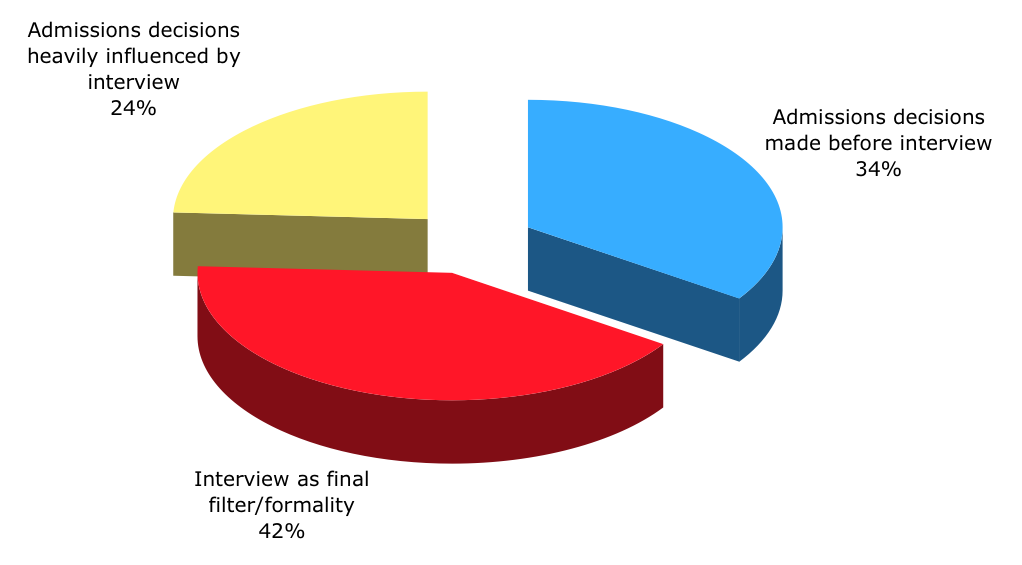
Last weekend, I asked how important is the grad school interview to admissions. As of Sunday, twenty-eight of my fine readers (plus myself) had responded to the survey on this subject.  A little over half had interviews before admissions, but only about a third of those indicated that the interview heavily influenced admissions decisions.

You can check out a detailed breakdown of interview importance by program and discipline on Google Docs. As I suspected, admissions decisions before interviews were more prevalent for physical sciences candidates (70%) than for bio peeps (20%).

Regardless of our individual experiences,  we mostly agree that the interview should have some role in the admissions process.

But what is it we seek to learn from a face-to-face interaction that we cannot extract from the pages of information required for grad school applications? Is it, as Bashir suggested, to serve mostly as a ‘sanity check’? A last chance to judge whether a candidate can hack it before investing time and money? Are there other subtleties or flags that we hope are fleshed out?

That brings me to today’s question.

Posted in graduate school | Leave a comment

Grad School Admissions – Paper vs. Person

It’s that time of year when most STEM departments at U.S. universities are winding down their season of interviews and recruitment weekends for their Ph.D. programs. But just what are those visit weekends for?

For some programs, acceptance (and rejection) decisions are made months before spring visits. Judgments of a student’s suitability for a program are based solely on what’s on paper – grades, GRE scores, recommendations, and personal statements.

In other cases, no decisions are sent out until the faculty have had a chance to interact with the candidates. The stock application serves as a filter to decide who meets the admissions criteria and who they want to interview. But the faculty want to see how candidates perform under pressure, how they might fit in with the department, or whether the they know what they’re getting into and why.

When I applied to mostly chemistry programs [redacted] years ago, all programs made their decisions prior visit weekends, and the visits were largely about recruiting students and interacting with potential advisers. From others’ experiences, it seems large, multi-departmental umbrella programs use interviews to sort the applicant pool further.

I’m curious – do the tactics vary by discipline? By program structure or size? Which programs make their decisions based on how a candidate looks on paper? Which committees want to meet face-to-face before making the call?

In 60 seconds or less, you can help satisfy my curiosity (and perhaps a few others) by filling out this quick survey. Just click below to get started.

In person or on paper? Take the survey.

Posted in biomedical workforce, poll | 7 Comments

The art of the sale

It was that time of the year again. I went to class, intent on my coursework as usual, but there was something else waiting for us at the end, the thing I dreaded all year*…

Catalogs and order forms. It was time for the school fundraiser.

Every year I was in elementary school, I had to sell something for the school. Christmas paper, donuts, chocolates, stationary… What we sold was different each year, but all students (and by proxy, all the parents and guardians) were expected to participate. We were supposed to be excited about the opportunity to pawn off overpriced trinkets and candies on our families and families’ friends. As added incentive, there were prizes for the top sellers of each class and grade.

I absolutely hated it. I would sheepishly hand the stuff over to the parents and grandparents, wait quietly, and dutifully return the forms to my teachers. I was never in competition for those prizes, and I never tried to be.

I am not a salesperson. I never have been. I would do most anything else for a club or school, but don’t ask me to go out and convince people to give me money…

What’s that?

Why, yes, I am pursuing a career in research.

Yes, as an independent investigator – if I can make it. What are you getting at?

Uh oh. Wait just a minute…

Damn it.

I’m chasing after a career that involves me asking people to give me money!

But this time I’m not selling keepsake boxes, M&Ms, or gift bags.

No, this time I’m selling myself and my ideas… Son of a biscuit eater!

You see, if there’s something that makes me near as uncomfortable as sales, it’s probably bragging about myself. Why? I don’t know. Maybe it’s a cultural thing. Maybe it’s a personality thing. Whatever it is, I. Don’t. Like. It.

Yet that’s what I’ve signed up for. Multiple times a year, I am to try to convince a group of people that I am brilliant. That I have clever ideas. That my work will provide some crucial and needed insight.

And this time the stakes are higher. I won’t be missing out on a party. I’ll be missing out on my dream.

I’m starting to pay attention to how I talk about my work and myself and how my adviser and other investigators talk about themselves, their work, and their trainees. And I’ve realized that a big part of this business is the art of the sale.

The art of the sale is about more than simply knowing what you have to offer. Presenting a list of facts, figures, and achievements isn’t enough.

The art is about telling a story. You lead people through the plot, connecting the facts while sparking an interest. There has to be a clear focus and a unique perspective but one to which your audience can connect.

The art is learning to brag – but with subtlety. You must be confident in the cards you hold but without being overbearing. You have to sell your talents without alienating those listening.

The art is about recognizing and creating opportunities. It’s not just about getting the grant. It’s about planting seeds without complete certainty that you will ever benefit. It’s about connecting with people at seminars and conferences. It’s about negotiating with vendors and company reps to get access to materials and instruments. It’s about collaborating with people near and far to push your and their research forward.

The art is knowing which ideas, avenues, and opportunities to pursue. And which to leave behind.

The art is going out and trying. And trying. And trying again. And never giving up.

* Forgive the hyperbole, but it makes the story better than the truth that I didn’t think about until the time of year came along at which point I terribly disliked it 🙂
Posted in career decisions, communication, for the love of science, sales, things they don't tell you in grad school | 9 Comments

The long wait…

I recently finished George R. R. Martin’s A Feast for Crows, the fourth book of the Song of Ice and Fire series. The series tells the stories of the rises of falls of kings and queens vying for rule of The Seven Kingdoms, the ensuing wars, a dark ancient threat at the edge of the realm, and the men fighting to protect the lands that have all but forgotten them. Each chapter focusing on tells character’s point of view, and there are many of them. Each book has taken on epic proportions. At the conclusion of the fourth novel, Martin explains that as he was writing, he realized the book had grown far too large for a single volume. He decided instead to split the volume, publishing the tale of some characters in A Feast for Crows and saving the rest for A Dance with Dragons. The afterword was dated June 2005, and Martin hoped to have the fifth volume out within the next year. I laughed when I read it, as I knew A Dance with Dragons was not released until early 2011.

Of course, life has a tendency of running amok amongst our plans and making us wait for things longer than we intended. This is true even in–or perhaps especially in–scientific careers. The experiments you propose to your thesis committee take twice as long as you think. You’re sure you will be able finish your Ph.D. in 4 years, no problem; it takes six. You’re certain that manuscript is almost ready to go; it’s finally published 2 years later… Rarely does research less time than expected. You’re waiting on other people or administrative clearances. Instruments break. You get ‘sidetracked’ by unexpected findings or other projects. Established techniques stop working, animal models aren’t consistent with previous work, or cell lines aren’t surviving, and you spend weeks or months troubleshooting, getting the system back to where it was so you can move forward at last. The reviewers want those additional experiments. Whatever the cause, your plans take longer than you think.

Posted in Time | 2 Comments