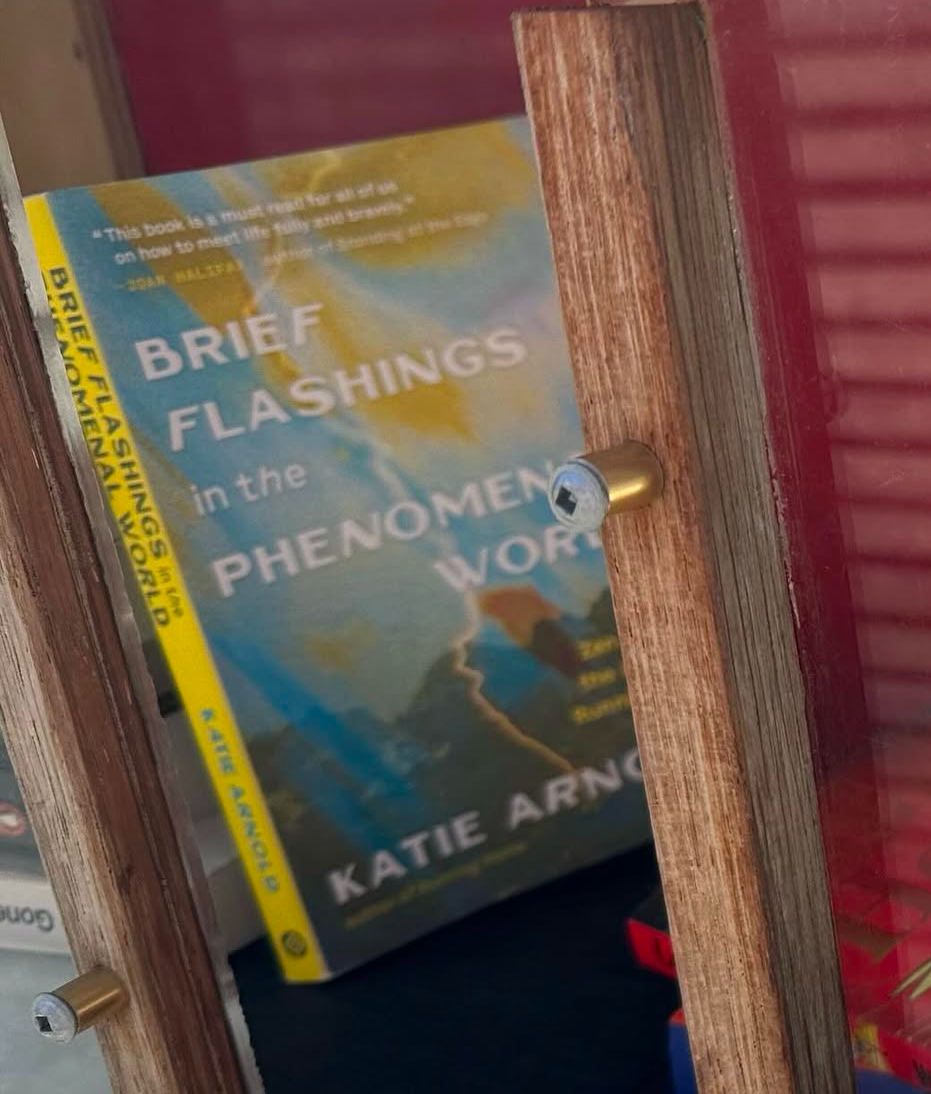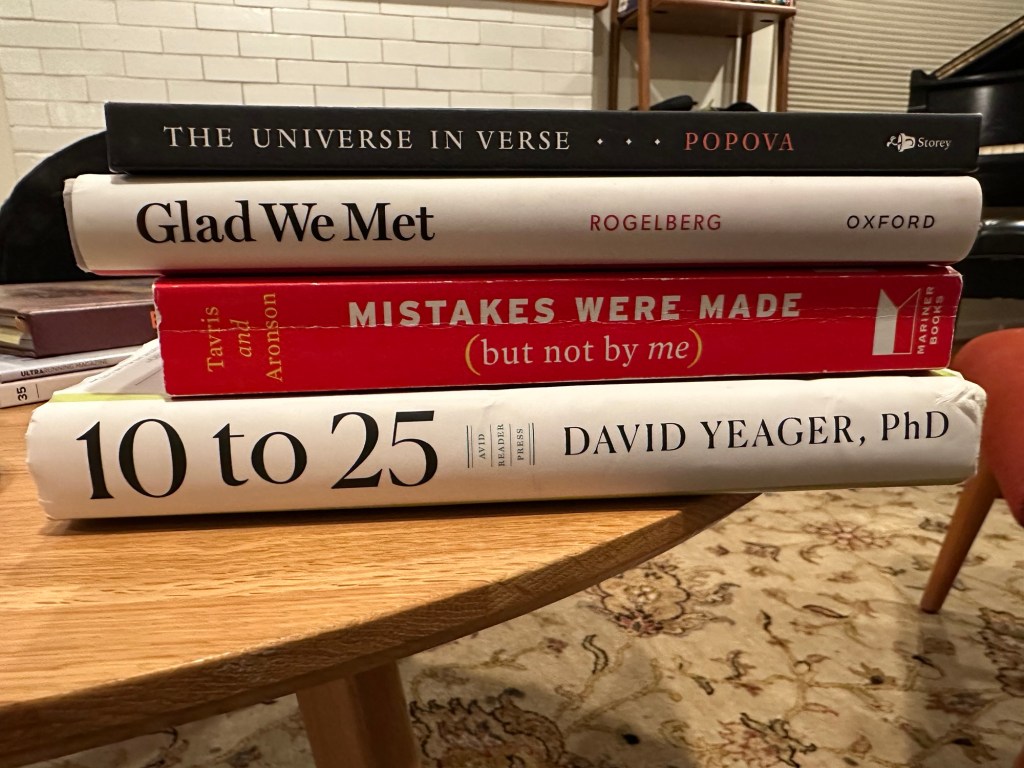
Books I read in October 2024

Here’s what I finished reading last month.

The Amen Effect by Sharon Brous

A meditation on connection & care. Focus on showing up in the difficult times. But also a reminder to show up for the celebrations too. Reinforces that connection starts with simply seeing the other person, even in their despair, even in if they’ve done harm.

Pair with How We Show Up by Mia Birdsong.

More from the author on Guy Kawasaki’s Remarkable People.

The Great Mental Models: General Thinking Concepts by Shane Parrish

Introduces the philosophy of learning different ways to view the world & applying them to decision making. Covers some general concept models, such as second order & probabilistic thinking. Quick read. For me, a recap of models I know, but sometimes it’s useful to step back & revisit basics.

Check out Parrish’s in-depth interviews on The Knowledge Project.

The Friction Project by Robert Sutton & Huggy Rao

Or why systems suck & how to fix them. Bureaucracy often isn’t the product of malice or apathy, but a series of decisions, often made in isolation. Defines out the traps that produce friction in systems and approaches that people at different levels of influence can use to overcome them. Also highlights where we should add friction to prevent harm, reduce errors, and even accelerate future work.

Really enjoyed this & it’s quite relevant to my work.

Key takeaways from the authors on The Next Big Idea Daily.

Build an A Team by Whitney Johnson

What if management isn’t all about employee productivity? Using the the S-curve model of learning, suggests organizations should largely select for growth potential over mastery, while providing support, mentoring & safe spaces to fail. Also watching for need to help people move to new S-curve, whether new hires not suited to role or those who’ve achieved mastery & are at risk of boredom & disengagement.

A cool way to think about employee hiring, development & retention—but the “ideal” balance is tough in small teams. Super quick read; knocked most of it out in a couple of 90-min plane rides.

Co-Intelligence by Ethan Mollick

One of my favorite reads last month. A measured take on how AI is already changing our world. Sets up AI as a partner, rather than a replacement, for human. Highlights different roles AI can play, while addressing risks—e.g., AI might be great at summarizing info, but what does that mean for human learning & information processing? As Mollick notes, the AIs we’re working with today are likely to be the worst we’ll ever see.

The future is here. How will we work with(out) it?

More from Mollick on Adam Grant’s ReThinking.

The Unspoken Rules: Secrets to Starting Your Career Off Right by Gorick Ng

No, I am not starting off. Picked it up as I thought about what’s now implicit/unconscious to me that might not be obvious to those new to the workplace, especially in environments different from those of their families/communities of origin. Acknowledges the impact that identities (including gender, race, ethnicity) can have on expectations & standards—and that these are systems that should change, while providing tips to navigate.

A good resource for those new to the workforce. Managers/mentors might find it useful to flip through or skim/share.

Author interview on HBR Ideacast.

Emotional Agility by Susan David

Provides a framework for understanding that many emotional reactions are hooked to experiences long ago—and learning to recognize those reactions, take a pause & unhook your response & action. After describing different aspects & strategies, covers how emotional agility can be used with kids & at work.

Author interview on On Leadership.

Posted in Uncategorized | Tagged | Leave a comment

Transforming Work-Life with Shutdown Practices

10:30 pm. I’m wide awake. Maybe that’s normal for you, but I’m an early-to-bed/early-to-rise sort of person. I should be descending deeper into slumber. But my brain is running through all the things I need to get done. The things I need to remember to add to my list tomorrow. The frustrations over things that have not gone perfectly, some beyond my control. It’s feeling like a long week. And it’s only Monday.

Eventually, I give in. My mind is not is a space for rest. I get out of bed, creep quietly upstairs. Find pen and paper. Start writing. List all those tasks I need to do or follow, which I’m not sure are on my list. Writing why I feel like I’ve failed, or at least not performed to the level I expected. I at least refrain from opening my computer, diving into some work. I would just be losing more sleep to soothe my anxiety, only to be less alert and engaged tomorrow. A vicious cycle, and this one already feels vicious enough.

Gradually, the racing thoughts slow down. I feel my body calming, my eyelids growing heavy. Time to try for sleep again.


That sleepless night was the final nudge I needed to add a daily ritual that I had been thinking about for weeks but yet hadn’t committed to: a shutdown routine.

Two months later, I truly feel like it has improved my life—even if I’m still struggling with its foundational purpose.

I heard Cal Newport talk about shutdown routines on his Deep Questions podcast several times. It seemed pretty simple. At the end of each day, check your inbox and attend to any urgent issues. If there are any new tasks arising from emails or notes, add them to your task lists. Scan your lists and calendar to look for upcoming deadlines or appointments. Create a rough plan for the next day. Once those steps are done, say a phrase (or do a small action) that affirms the routine’s completion and ends your work for the day. As I understand it, the goal is let professional concerns go for the day. If something comes up, you note that you’ve addressed it and let it go.

Of course, this ritual must build on some preexisting practices. Fortunately, my theme for 2024 is systems. I’ve been playing throughout the year with approaches to help me manage my tasks, time, and energy.

My Bricks

I am a tactile creature. I prefer to take notes by hand. I had been keeping a task list in my ‘everything’ notebook (inspired by Raul Pacheco-Vega, though mine is not quite as structured). But late last year, I started feeling defeated as some tasks were constantly being carried for, week to week. I also found I was struggling to keep track of work on hold, waiting for others’ feedback or contributions. Through some trial and error, I’ve developed a system that’s working for me.

Digital task boards form the foundation. I am using Smartsheet, because we already use it in my workplace. Plus it has nice features for task tracking, such as file attachments, comments, and an Outlook add-on that can appends email messages to a row. I default to card view, in which top level tasks are shown as cards organized into lanes based on status.

Newport advocates for one board per role. Depending on how you slice it, I had a single role or many that are difficult to separate. I started with a single comprehensive list of my own work. I am adjusting the system as I realize a need or take on a new role. For now, I have 3 boards:

  1. Operations management role: I recently took on new responsibilities for our institute’s operations and administration. This work is clearly distinguishable from my other tasks. It is focused on processes and protocols, and I aim to keep it contained in specific time blocks. Creating a separate board for this was a no-brainer. It reduces the distraction when I’m doing this work and when I’m focused on other roles.
  2. My other work: This was the original comprehensive list. It captures all work I’m responsible for outside my operations role. This includes my primary role in research development, strategic and tactical planning for our upcoming major grants, reports, people management, presentations, support tasks for other teams… As I write this post, I am beginning to see how I might split this board up.a
  3. Research development team status: Different brains work different ways.b I don’t want to force others to adopt my precise way of working—especially when I’m still figuring it out myself. But I have two direct reports with projects and activities for which I am accountable but not responsible.c This board is less granular than those above offers work visibility across my team, so we can see where we have capacity or might be approaching overload.

I’ve outsourced memory to these lists, so I worry less about forgetting things.

Handwritten lists shape my day. At the start of the year, I found an elegant physical to-do list tool called Analog. The premise is simple: Use one Today card to capture your meetings and to-dos for the day. But it offers only 10 lines, which forces a cap on the number of activities you try to take on. Depending on the size of the task, I often find 10 is even too many. Analog also includes Next cards to capture important tasks to do later and Someday cards for goals and aspirations for the future (I’m still figuring out how to use these most effectively).

Yes, I could use a notepad or a digital tool, but I prefer the physical weight of the cards. It almost serves as an anchor that helps prevent me from straying too far from the tasks at hand.

I like the back of the cards, which has a simple dotted grid for the user’s choice of purpose. I tried practicing daily reflections before, but it never stuck. With the Today cards, I began writing down my thoughts and experiences each day. I’ve kept at it for months now and find it very useful for seeing patterns and gaining insights. (More on this another day…)

I would write my reflections and prepare my Today card, either at the end of the day or at the beginning of the next one. But I hadn’t established a formal end-of-day ritual yet.

The Mortar to Bind the Bricks

I didn’t have a habit of clearing my inboxes—digital and cognitive—each day. Waking in the night to the hum of racing thoughts was… well, a wake-up call.

Since I had the core pieces, creating a shutdown ritual was pretty simple.

I set aside 15 to 20 minutes at the end of my workday. I added a reminder to my calendar and included ‘Shutdown routine’ as the last item on my daily card.

During this time, I mostly follow Newport’s model. I now clear my primary email inbox empty at the end of each day. If I can resolve with a quick response, I reply. If a message requires action, I create or update a card in the appropriate list, then move the message to a ‘Work queue’ folder. I file informational/update messages in relevant folders. If something piques my interest but isn’t time sensitive, it goes into a folder for review later. Other messages are simply deleted. I use Outlook’s Other Inbox and rules to keep my primary inbox sparse (e.g., listserv messages automatically go to a specified folder for bulk review). Plus I manage my email a few times per day. The end-of-day clearing usually takes just a few minutes, unless there’s an urgent fire to deal with.

Then, I go to my digital boards. I update card statuses and add comments to keep track of developments. I add cards or sub-tasks I made throughout the day. Now I know my task lists are up-to-date.

Next, I move to my daily reflection. I’ve finished my tasks, but I haven’t planned for tomorrow. So I can focus on my experience and understanding of what happened or what I learned today.

Finally, I set up my Today card for the next workday. I open my calendar to review my schedule, checking for any early or late meetings that require adjustments to my routine. Sometimes I decide to drop a meeting or webinar to make space for more focused work. I select a few priorities from my boards as tasks for the day. Then I put the card where I will see it when I arrive at my desk the next morning.

Results—and Room for Improvements

I revealed the conclusion at the start. The shutdown routine helps me have fewer work-related thoughts during my personal time.

Where I often fail, though, is letting work thoughts pass by when they do arise. I worry less about forgetting tasks since I’ve recorded them, and they’re just waiting for their moment. But I am realizing that I often carry some of the emotional response and cognitive processing with me. If there’s a knotty problem, my brain has trouble setting it aside.

I haven’t consistently used a clear cue to acknowledge the end of my ritual. After finishing his routine, Newport says aloud, “Shutdown complete.” Could something so small shift my lingering attention on work? Perhaps. But I think it’s will likely require more psychological/mindfulness training for me.

Even so, this simple method to clear my mind and get ready for tomorrow has significantly improved my work and life in just two short months. I’m eager to see how this practice continues to evolve.

Footnotes

a Another personal reminder of the value of spending time on writing, even if it’s seen by few, and why I often take longer than planned: Writing is thinking.

Of course, I also put more time into writing ‘simple’ posts than expected because of asides such as in these footnotes 😅

b A great example: Cal Newport and Oliver Burkeman, two thoughtful voices in the productivity space, talk about shared philosophies and tactical disagreements.

c In professional project management, we distinguish accountability from responsibility. The accountable individual is the person who “owns” the work. They need to make sure the work gets done and meets specifications, even if they’re not doing it themselves. There should only be one accountable party. The responsible individuals (one or more) do the work to yield the deliverable. You can be both accountable and responsible, but as you move into management, you’re often delegating responsibility while retaining accountability. Responsibility and accountability are half of the RACI chart roles.

Posted in Uncategorized | Tagged , , , , , , | 1 Comment

Books I finished in September 2024

It’s been a while… again. Blogging has been a sporadic activity in recent years. Yet I’ve felt the tug to write again for some time. So here I am again, seeing what I can make of my blogging spaces. If you’re interested in my running adventures, pop over to my other blog for a recent post about my experience taking on one of the toughest 100 milers in the United States.

In recent years, my reading of books has picked up again, though 2023 had a dip. I have already read more than twice as many books in 2024 as I did last year. I’m trying something a little different here. Inspired by a favorite podcast and a couple of newsletters, I’m sharing the books I finished reading last month. The goal here isn’t deep analysis. I only want to share a few thoughts on what I’ve read. So without further ado…

September’s list

September was an unusually high month for books completed. In no particular order…

1. The No Club: Putting a Stop to Women’s Dead-End Work by Linda Babcock, Brenda Peyser, Lise Vesterlund, and Laurie Weingart

This book arose from a group of high-performing women feeling overwhelmed by the work they had committed to, eventually producing a line of research to better understand how they (and many other women) ended up in their state while simultaneously helping each other push back and rebalance their loads. The central premise is that women (as well as people of color, and especially women of color) take on a disproportionate level of non-promotable work. This moves beyond the “office housework” concept in which women take notes, fill coffee, and plan celebrations. It also includes activities that may be important, even critical, to the organization but that do not generate the “currency” that is recognized in promotion. In the academic setting where these authors work, this included things like curriculum design and IRB service whereas their promotion and tenure depended on research and publications.

Honestly, a lot in this book will come as little surprise to women who have worked professionally for any length of time. One thing I appreciate is how they highlight the impact of this type of work across different professions and how they debunk many of the assumptions about why women end up doing more of this work than men. Even though the authors are academics, they also provide very practical guidance on how to identify and evaluate the promotability of work, acknowledging that it will change across contexts (including career stage), and strategies to reduce the amount of non-promotable work you take on. I’m hoping to return to complete the exercises they outline at the end of each chapter to better understand how this might play out in my own role.

2. How We Show Up: Reclaiming Family, Friendship, and Community by Mia Birdsong

We have developed and internalized many social and cultural norms about what family and friendship is supposed to look like. In American society, at least, this is stereotypically rooted in the nuclear family and familial ties, with spouse/partner filling many roles. Mia Birdsong draws on different visions of family, friendship, and community that have been created, often by members of marginalized groups who were ostracized from or simply didn’t have access to the “traditional” structures that media, popular culture, and even government elevate.

This book (along with The Amen Effect by Sharon Brous, which I started in September) have me examining my spaces and thinking about how I show up and what my sense of family and community might look like. I have gained significant levels of privilege in my life, but the “traditional” family and friend structures that I grew up with don’t fit my life. I am married to a man, but there are no kids in our future. I’m still a few years out from turning 45, but both my parents are now dead, I live on the opposite side of the country as my remaining family, and those relationships have grown more and more distant over time. I don’t have conclusions at the moment. But I have some hope that we can imagine ways forward.

3. The Art of Living by Thich Nhat Han

I originally picked this up in April 2023, heading to a mindful running retreat in Nepal and Bhutan. When I returned, it was tucked into some spot out of sight—until I relocated it again a few months ago. It’s not a long read, but it’s one I’ve moved through slowly. I’ve found myself drawn to many tenets of Buddhism, expressed here and in other readings and listenings in recent years. This book delves deeply into the concept of interdependence, letting go, and the art of presence. Perhaps one of the most significant lessons I took was that “being present in the moment” does not mean releasing aspiration, but rather perhaps our rationale and attachment to aspiration.

4. Deep Work: Rules for Focused Success in a Distracted World by Cal Newport

My first Cal Newport read was A World Without Email in 2020. I quickly devoured Slow Productivity when it was released earlier this year. I’ve listened to his podcast Deep Questions for years, almost always taking away something meaningful. And I’ve heard Newport and others talk about Deep Work (both the book and the concept) for a while. But I hadn’t picked up the book until The Growth Equation Academy selected it for their book club, associated with the theme of humane productivity.

Yet I think I read this book at just the right time. I’ve been working on building habits and routines this year that will clear the way for a more sane, sustainable approach to intense work projects next year. I had been implementing some of Newport’s systems (learned from his podcast and other books). But the deep dive into Deep Work helped some ideas click into place. Similar to the first book on my September reading list, Newport balances an exploration of academic research with personal experience and practical strategies and tips for establishing a deep work practice. And in fact, as I read The No Club, I found myself thinking back to Deep Work principles.

I’m now working more intentionally on carving out time for deep work and understanding what demands that level of focus and how to best prepare myself and workspace for it. His Q&A for The Growth Equation Academy also has me thinking about how to encourage and support my team to integrate deep work practice into their routines.

5. The Political Determinants of Health by Daniel E. Dawes

More and more, people have been recognizing that developing new medical interventions is not enough to change health at a population level in the United States. Rather many issues are driven by social determinants of health, non-medical factors such as income, education, zip code, and health care access. This book pushes further, positioning political determinants including policies, systems, and politics as ‘determinants of the determinants’—i.e., that it is voting and the legislation passed that change or maintain the social determinants of health.

Daniel Dawes, a lawyer and professor, provides a brief history of health equity policies at the federal level, effectively going back to the founding of the United States. A centerpiece of the book is the development, passage, and preservation of the Affordable Care Act. Dawes offers incredible insights, having been at the forefront of this legislation. I think there are many excellent lessons here for folks interested in health policy. As someone who is not a policy maker or advocate, though, I think this text provides a critical reminder of the importance of voting and contacting elected officials in moving the needle on seemingly intractable problems in our society.

Posted in Uncategorized | Tagged | Leave a comment

A theme for 2024: Systems

I’m not one for resolutions. To me, they often felt too rigid, prescriptive. Or maybe that was the perfectionist who understood goals as all or nothing, not only in the what but the how.

I do, though, pick a word or theme for the year. I think I first picked up the idea from a post by Cate Houston (I could go back in the archives & confirm, but I’m trying to get this written & practicing letting little things go sometimes).

Reflecting on 2023’s word

Unusually, I didn’t write about my word last year. I did pick one, but it never made it to the blog. It didn’t even make it on a post-it by my desk. So when my husband asked me what my word was last year, it took me a while to resurrect.

Space.

2023 was meant to be a year to carve out space. To not fill my days with more. To commit to shaping spaces, physical & temporal, to better support my life.

We had just moved into a new home, same city but a place that we own pay the bank (rather than a landlord) for each month. We wanted to create a comfortable living space. We did.

I ran a lot of races in 2022, and Gene was training for Ironman. We’ve been talking for years about mountain adventures we wanted to go on, but training and events limited the time. In 2023, we committed to keeping space in our schedules for those outings, and we had some incredible days in the mountains together and with friends.

At work, I stepped back from a few things that were not really serving what I needed to focus on. It was fortuitous I suppose, as personal and professional events placed more demands on my time. The space I created was rapidly filled, then over filled. Whole it was a successful year in many regards, I didn’t succeed at holding that space.

2024: A year for systems

This year, I’m doing something unusual. I’m taking a word someone else set for their year.

Well, that’s not quite right. It’s something I kept finding my focus drawn to over the past many months, especially as work got busier and some things were sliding far down the priority list. Systems also kept coming up in my reading, listening, and conversations. I just hadn’t found the single word I was looking for until seeing Ryan Holiday’s post last week.

2024 is a year of preparation. Next year, I will be managing a large project at work—the sort that keeps our institute running, or not. This year, we are undertaking planning work, essential to the project.

But that’s not the only preparation I need. I know from prior and ongoing experience that other work doesn’t stop just because we have this big thing going. There’s still the day to day. There are still new shiny objects that can be hard to ignore. There are still the unplanned changes that throw things out of balance.

This is where systems come in. The truth is, in many cases, I have systems—but they’re not always explicitly articulated or working optimally. How do we make decisions about which projects to start or stop? I have guidelines, but they’re mostly in my head. How do we make information about complex processes, in particular the “institutional knowledge”, more accessible? I know shared notes and process documents will improve our recall and reduce reliance on individual memories, yet that’s the work that’s easily forgotten when we get busy or just tired.

Whether they’re working well or not, whether they are operating as intended or not… Systems are embedded and shape our behaviors. If we want them to work for us, to improve our lives, we have to build/borrow/use them with intention.

This is my time to do that.

Posted in Uncategorized | 2 Comments

More of less

What could you do more of?

Ah, the ever human pursuit of doing more…

More exercise, more love, more reading, more writing, more work…

More, more, more.

But maybe what we need more of is… less.

More rest and recovery from the effort we put in so we can grow.

More saying “no” to doing more so that the top priorities get the attention they deserve.

More subtraction—taking tasks off the list, simplifying process, setting aside the tools and things (physical and emotional) that no longer serve us—so that we have the space and time to focus on what matters.

More of detaching ourselves from the persona whose perceived worth is entangled in how much we do, how busy we are.

How do we get, how do we embrace, doing more of less?

Posted in Uncategorized | Tagged , | Leave a comment