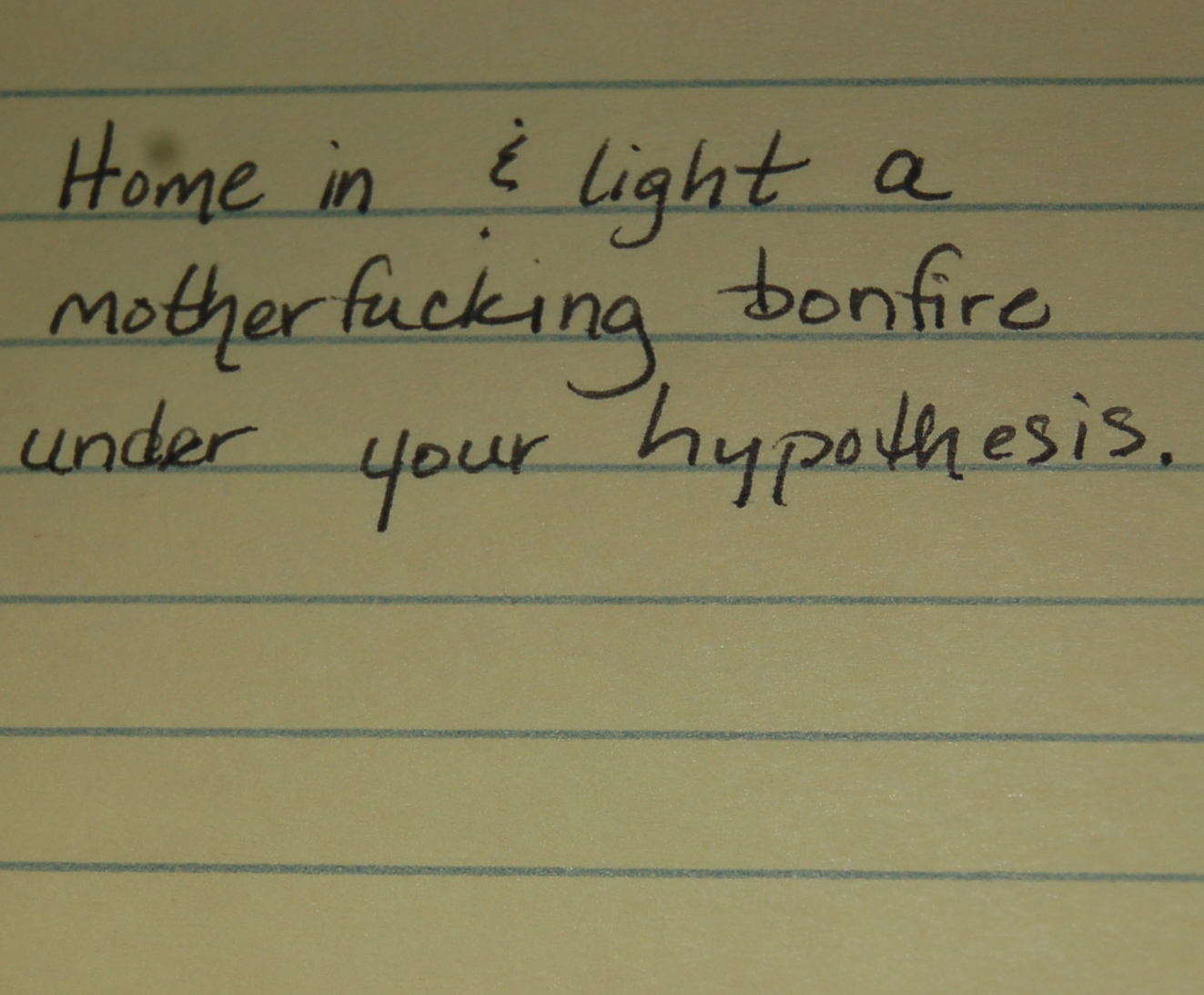
My future foretold

A not-so-excellent comment on an excellent post by Dr. Isis:

If we all waited for tenureship [to have children] there would be a lot of bitter dried up old childless prunes. This is eexactly the attitude that encourages departments to be filled with the old boys network + childless humourless females.

I can hope that PhysiolMum was referring only to women who want kids at some point in their lives but keep putting it off and not to those who have no emotional or biological drive to have kids–like myself, a woman who is pushing 30 and has no desire to interact with children on a daily basis, even if they were my own. Otherwise, it seems I am destined to become a bitter, dried-up, old, humorless female in the old boys club. Perhaps someone should warn Paramed.

Posted in rant, women in STEM | 7 Comments

Simple Essentials: Analog tools I love

Technology has changed how we do things in many ways. If you have written a grant, review article, or dissertation, you can appreciate how it’s made that aspect of your life easier. Have you ever thought what it would be like to go back to pre-ref manager days when you’d have to curate and cite your bibliography by hand? It was a pain in the ass in high school and undergrad when you only had 10 to 30 references. Or what about typing your entire dissertation on a typewriter? I shudder at the very thought! No spell check, no grammar check, and setting the margins and spacing manually… One mistake and you might have to go back and retype the entire page (or chapter) to correct a mistake or satisfy the dissertation format drill sergeant.

Despite the wonderful tools the digital age has brought us, sometimes there is no substitute for a simple, frills-free, analog approach. Inspired by a recent camping/biking trip, George Williams at ProfHacker started thinking about the “simple tools essential to my academic life“. He comments:

At a certain point you have to realize that it’s not about the gear you’re using; it’s about what you do with the gear…

My realization made me start thinking about other areas of my life—and, specifically, my academic life—in which I’ve opted for simple, effective gear instead of fancier, more complex alternatives. Why? Because I think we all run the risk of chasing the next big thing instead of assessing whether or not we have a real need that our current gear doesn’t satisfy.

Likewise, in research, there are always new slick applications or instruments debuting, to bring us into the age of “Science x.0”–e-readers, electronic notebooks, protocol wikis… Some digital tools have already proven their utility, others likely will with tweaking and increased use, but some may never (at least in my career) replace their analog counterparts. Here are some of my simple essentials:

Lab notebook

There are several electronic lab notebook (ELN) applications out there. Particularly in cases where patents are likely to be filed, I can see the appeal of ELN for the purpose of creating an audit trail that (I presume) is harder to backdate. However, I don’t see myself embracing ELN. Give me a bound notebook for recording my experimental methods and results. I prefer something that I can scribble in, jot down calculations, attach dried polyacrylamide gels or films from developed Western blots, write thoughts for how to improve the experiment or what to do next… For me, there often are electronic elements–experimental methods that are used often with small variations, indices for notebooks, calculations and data sets from various instruments–but even when these are used, they still end up printed and pasted in.

Notepad/notebook for seminar and conference notes
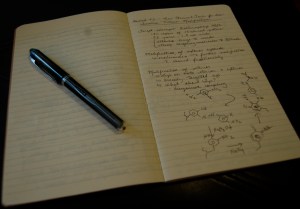
A pair of classics

First: Yes, I really do take notes during seminars and conference talks. Second: I have tried taking notes for a meeting on my laptop, using Microsoft Word “Notebook” format, and I didn’t particularly care for it. There’s the clickity-clack of keys, which I find a distraction to myself and (no doubt others). And I can’t figure out what to do when someone throws up a diagram or structure or important equation. Then there’s the linearity of the document that makes it difficult to quickly jot down a thought or question about an earlier point that pops into mind later on. I much prefer having a bound book for such talks. Because I do actually refer back to these notes on occasion, I prefer to keep a dedicated book for seminars, one that’s separate from lab meeting notes and the scratch pad for jotting down things I need to do. Moleskin Cahier journals are my favorite for this purpose. They’re small enough to fit easily in a meeting abstract book. The narrow lines fit my handwriting. They’re durable. And they’re just the right size to contain all my notes from a five-day conference without having to shoehorn in the last talks and without having many blank pages left.

Ink pen, black or dark blue

This is my requisite accoutrement for the first two items. When I can afford them, my preferred choice is uni-ball® Vision Elite Rollerball with Micro point tips. I avoid click-top pens for general writing and meetings so I won’t be clicking incessantly when not writing. I like the micro tips for the nice narrow lines of script, and I’ve never had issues with the micro tips of this brand bleeding all over or through pages.

Lab tape + fine to ultrafine Sharpie

Do I really need to explain this one? Lab tape is almost to the research world what duct tape is to the outside world (although we do have our own uses for duct tape too). Combined with Sharpie, you have an instant label for almost everything–bottles, shelves, boxes… I’ve also used lab tape to label the spines of my research notebooks, so that I can quickly locate the one I want when they’re all lined up on a shelf. Oh, and when I say Sharpie, I mean Sharpie®. I’ve used VWR lab markers, and although their ink is solvent resistant, they are lightyears behind Sharpie® in every other regard.

Sticky notes and flags

In addition to jotting down reminders to myself, sticky notes are great for buffer/reagent recipes that are constantly used. Rather than double checking my notebook every time, I just pull the sticky off the wall and take it to the balance. Small post-it notes or sticky flags are useful for marking notebook pages that I may need to consult frequently, such as protocols.

Dry erase board and markers

I love having access to a whiteboard. And I’m not talking about a small one–I want a big one that nearly takes up the entire width of a decent-sized wall. Why do I desire one of this size? Because this is where I do a great deal of thinking. When I’m trying to pull together data from multiple experiments/sources to generate a conclusion, model, or hypothesis, I need to see all the information in one space. This process is very much nonlinear for me, and sitting down with bullet lists or stacks of data is not so helpful. Sometimes I just need to sit and stare at the information, to let my mind wander from point A to B to G and then back to B–without having to shuffle through a stack of papers or flip through notebooks. At one point in grad school, I filled a whiteboard (~5′ x 10′) with data, open questions, and hypotheses for one particular question we were trying to answer. As I ran out of room, I started taping notes to the board with questions or proposed experiments relevant to a particular point. Once finalized, Bear took a picture of it–either to preserve it for posterity or as evidence for the level of crazy wrought in his lab, I’m not sure which. Whenever I end up with an office of my own–either at work or at home–I will probably transform at least one wall with whiteboard paint. I suppose it can be one of my eccentricities, opening the door for jokes about the fumes from the dry erase markers getting to me.

What about you?

What technology-deficient tools keep your work going or organized week to week and day to day?

Posted in tools of the trade | 6 Comments

To be me again…

Yesterday I finally had that moment where I realized I’m beginning to feel like me again.

Maybe you know what I mean. For quite a long time now–at least a year, if not closer to two–I’ve felt out of sorts with so many aspects of my life.  I just didn’t feel like me, like the person I’d become over the preceding years in undergrad and grad school–and I rather liked that person. She spent hours thinking about a problem because the puzzle fascinated her. She was almost constantly soaking up new information. She knew when and how to stand her own. She trusted and respected her colleagues and mentor, even when she didn’t agree with them, even when she was royally pissed off with them. She valued and committed time to the things outside of the lab that kept her healthy and sane. She knew where she was going and had some idea of how to get there. She was often consumed by her work, but she didn’t mind most of the time because she truly enjoyed it. She was still an introverted, massive geek, but she was generally a fun person to be around.

This other person I’ve been… I haven’t particularly liked her. She let most everything that kept her sane and healthy go. She let her boss walk over her like she was his doormat. She rarely stood up for herself and was easily cowed. Desperate to make friends, she ignored that first gut instinct about the self-centered sleaze ball… until she let herself to be placed in a situation where true character was revealed. She had no passion, no fire for what she was doing. She had little confidence, drive, and optimism and far too much doubt, anger, and restlessness. She was, frankly, a train wreck and a miserable person to be around.

I’ve struggled over the past months to rediscover that person I was in grad school. It has definitely not been easy. I got a few false starts that died out. Now, I finally feel like I might be back on the right path. Some things are different. My ideas about where I’m going and how to get there are less clear now. That’s not such a bad thing because it’s forced me to think about plan B… and C, and I think it’s taught me to not anchor who I am to what I do so heavily. Sometimes I still feel a bit unfocused, but I’m getting there. I started implementing a more rigorous routine. I eat better, I drink less. For the moment, I have conquered the chaos of the apartment and am successfully combating entropy. My scientific curiosity and passion has been reignited. I’m looking forward to getting back to scientific questions that fascinate me. I’ve begun again to read papers, unrelated to current or future work, solely because they interest me. I’ve even started working on my research bible for my next project. I’m running consistently now. I went out for nearly an hour yesterday–just me, the road, some music–and I was happy to be by myself. I’m starting to feel comfortable in my own skin.

It just feels good to start feeling like myself. I’m going to try very hard not to lose that person again.

Posted in advisor/trainee interactions, attitudes, balance | 6 Comments

Cleaning day

Achoo! Hmm, it was getting a little dusty over here.

I’ve been blogging over at LabSpaces for about six weeks now. There’s a great, fun group of bloggers over there, and I’ve been enjoying myself. However, I find that I sometimes crave the simplicity, the freedom, and the zen of my solo space. So I decided it was time to clean this place up a bit, maybe spend a little more time here. This isn’t a defection, by any means. I will still be posting at LabSpaces every week or so, but I will also be writing here. I initially was not interested in maintaining two blogs, but sometimes I have things to say that might not fit well in the LabSpaces arena. I haven’t decided how everything is going to sort out yet. I think LabSpaces will be reserved for a specific set of post topics (probably related to science policy/politics), other stuff will go here, and there will likely be some cross-posting. I’m kind of figuring this out as I go along. Thanks for your patience while I sort it out!

Posted in blogging | Leave a comment

The Changeup

A few years ago, the end of my PhD was in sight (even if it was a bit hazy and afar), and thus the time had come for me to decide what I wanted to do next. I had spent four years working in a interdisciplinary* lab where the focus, broadly speaking, was how chemistry drives biology at a molecular level. It was something that I really got and truly enjoyed thinking about and working on. But I was a bit restless. I wanted to expand my horizons, and what better time to do that than in a postdoc. I chose an discipline that fascinated me and in which I saw opportunities to create a niche, bringing together approaches from my background and this new discipline, that would be be beneficial to a lab and my future career.

As you’ve probably gathered, things did not go as planned. I spent a great deal of time and tears trying to figure out what went wrong, what I could have changed, what warning signs I missed. I realized that there was more than a little naivete about how smooth the transition would be and why. Here are a few things I wish I’d known before trying to make a switch-some of which I probably did, but didn’t consider:

Be mindful of the “personality” of the discipline. Every field is different in its interactions and spirit. Some are quite open with data and ideas, whereas others are more secretive. My PhD field fell toward the middle of the spectrum: We were careful about putting forth the really hot stuff in large public forums unless we felt we were close to submitting for publication, but at the same time, you could have very open discussions about research at and away from your home institution. In my first postdoc field, people play their cards close to their vest. Little is discussed, even within your own department, unless it’s publication ready. Many colleagues and collaborators act like scientific frienemies. It can even carry over from departments into labs, where individuals won’t share protocols because they consider them “mine, my own, my preciousssss”. The drive for secrecy seems to be determined in part by the methods and reagents used. If most labs use the same techniques with commercially available resources, then there seems to be extreme paranoia that, with one wrong slip of the tongue, someone else can and will pick up your idea, run with it, and scoop you.

Choose projects wisely. This is important for any postdoc, but more so if you’re moving into a new field. Because you don’t know as much about the field, you might not appreciate just how difficult the project your PI proposes really is, until you’ve invested a great deal of time and energy. Again this can happen to anybody, even if you stay in the same field, but it’s much easier to get in over your head when you don’t know the field well.

Pay attention to which individuals are successful in a given lab. Generally, when you’re looking for a postdoc lab, you take a look at its publication record, seeing how often they publish and where. Most likely, you focus on the last author. If you’re switching fields, also consider the first author and his or her background and role in the lab. In my first postdoc lab, the productive postdocs (i.e. those with first author publications) were those that had trained in the lab’s major discipline or something closely related. There were a few individuals in the lab who came from different fields. Many of them left without any first-author publications-or any publications, at all. In this case, it was an unrecognized indication that one was expected to be a near-expert in the lab’s field with little training or education in it. The support and patience for the transition simply wasn’t there.

Don’t take my cautionary tale to mean you shouldn’t make a change, if that’s what you want. I have no doubt that changing fields works for some people because I’ve known highly successful scientists who have done just that. But I’ve also met other young scientists like myself that have tried going in a different direction and too soon find themselves in the midst of a train wreck. Much of this has to do with the dynamic of a lab, project, and PI, but some part of it can be the transition to a completely different field. Soon I’ll be moving onto another postdoc where I’ll be getting back to my roots; it’s still quite different from my PhD work but back to the things I love-proteins and their chemistry. My forays into other fields may not be over completely, but they will be more tempered and more rigorously considered in the future.

* Apologies to Carl Zimmer 😉

Posted in career decisions | Tagged , | Leave a comment