#Januwordy: The Deceptive Course

Since Saturdays oft entail an early start and a lot of running (almost six hours on trails yesterday), I’ve decided that Saturday will be my “rest day” from Januwordy. For Sunday, I’ll pick from the four prompts of the weekend (or something else if I’m not feeling them). This post brings together two: “deceive” and “course”.


Around the time I started driving regularly, MapQuest became a thing. It was a fantastic tool. Plug in the start and end points, choose the route, and print out the turn-by-turn directions. No more squinting at maps with small markings and using measuring tools to figure out distances. A few years later, I had a GPS gizmo in my vehicle, so I didn’t even have to print anything. Within a few more years, my phone had a GPS transceiver and Google Maps on board. Over time, more options and information were added to Google Maps, and it became a useful tool for driving, and in some locales, public transit, walking, and biking.

We’ve come to rely on these devices and applications. They’re wonderful tools not just for getting from point A to point B by the fast route. Through integration with other apps like RunGo, MapMyRun, and GarminConnect, we can plot our own course, meandering through places, playing with distances and elevations, choosing routes to take us by points of interest.

These technological solutions work great—when they have good data. Good data abound in municipalities and places that are easily accessible by car. If you begin to venture into more “remote” areas, natural areas and forest accessible only by foot or bike, the data quality at the heart of Google Maps—and thus the utility of the tools relying on it—begins to break down.

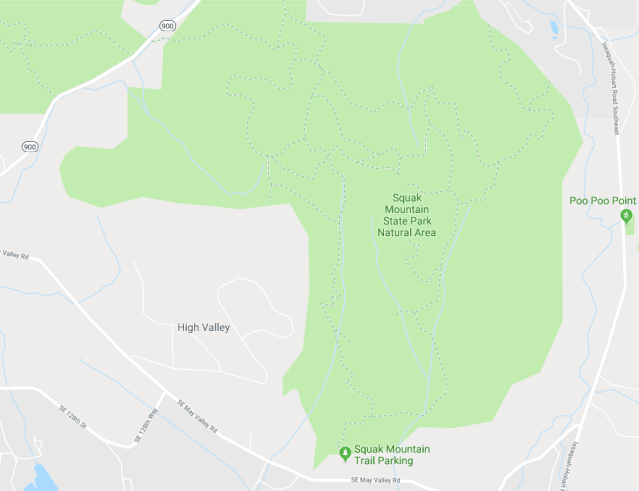
Here is Google Maps view of the trail system in a Washington state park.
screen-shot-2019-01-06-at-2.00.20-pm.png

Admittedly it carries more detail than I might have expected. But let’s take a look at another representation of the same area (from AllTrails).

screen shot 2019-01-06 at 1.58.36 pm

The first thing you might notice is that Google’s version is missing several trails. You might also notice that Google’s version lacks a bit of detail in the trails it does have, essentially showing a smoothed curve version of the trails.

There are two problems here.

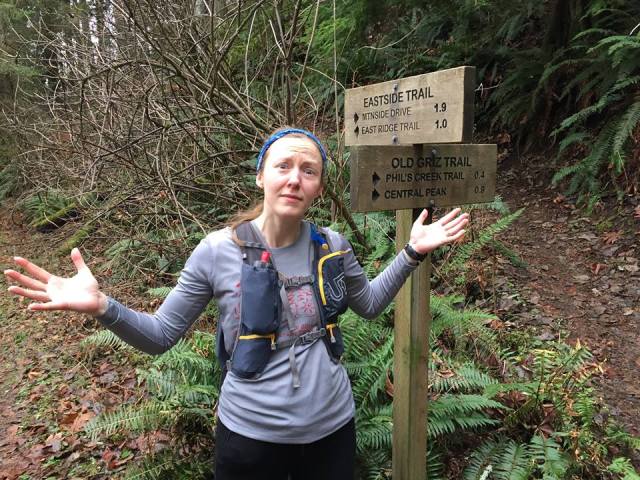
The simplified map means that you will come to intersections that don’t exist or look different in Google’s map. Trails are confusing enough as is, and unknown forks become more challenging to navigate. It looks like the mapped course goes straight, but is it the one to the left that heads down hill or the one to the right that heads up the mountain and sort of parallel?
49321424_676308089432856_8844088199409041408_n

Even if you’re paying attention or have an app/device to tell you you’re off course, you’re still spending time retracing your steps and adding distance beyond what you planned.

The other problem is related to planning. Hiking and biking trails tend to wind a bit and have switchbacks to take you up and down hills (the 10-15% grade on switchbacks is probably preferable to tumbling down a 40% grade for the most part). Google Maps lacks a lot of that detail, which translates to shorter expected distance than actual distance—sometimes by more than 10%. From a physical fitness and planning perspective, that might not mean much when you’re talking about three or four miles, especially if they’re flat. But 10 or 20 when you’re heading up and down a mountain? That kind of accuracy probably isn’t dangerous if you prepare for the unexpected (as one should on trails), but it can be painful.

The truth is, even good maps suffer these issues but to a far lesser degree. And of course no map is immune to trail changes—washouts, closures, detours, reroutes—that haven’t been reported yet.

This turned a bit more technical than I’d planned, and if you made it this far, thanks for sticking with me. Somewhere in my head (which is currently muddled by running 28 miles with 5500 ft vertical gain over two sessions in ~26 hours), this connects to life more broadly.

Throughout life, we often look for guidance, something or someone to show us the way to where we need or want to be. Advice can be incredibly valuable but also unwittingly deceptive. Sometimes advisor doesn’t have (and never had) the full picture, either of the individual or the environment. Sometimes the landscape has changed. New paths have emerged, while others have become more difficult to traverse. We can fall into a false sense of, perhaps not security, but knowing. We come prepared to face challenges, even planning for the unexpected. Yet somehow we still fail to account for errors between the expected and the actual and are surprised by how long (or how far) the planned course takes us. We also might not appreciate the physical, mental, or emotional toll that it’s going to take.

Even the best laid course, perfectly executed, won’t match precisely with the plan or the vision. Some of its error in the tools we use to plan. Some of its error in the tools we use to measure our effort. Ultimately we have to decide how to manage our expectations and what metrics truly matter.
Posted in Uncategorized | Leave a comment

#januwordy: Ascending to failure

img_6826

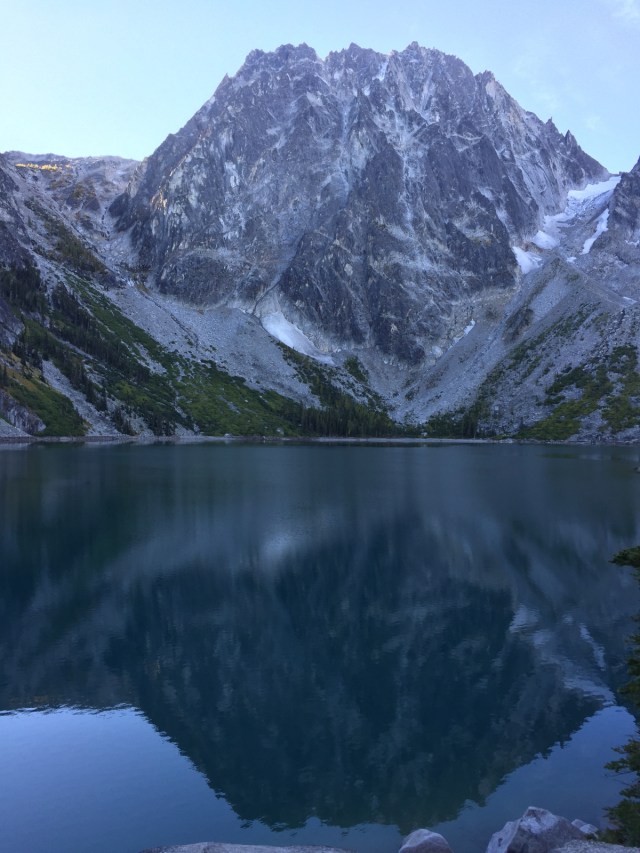
The further we went, the more anxious I became. We had been hiking up for this mountain face a while, the pace slowing as the incline became steeper. We began to occasionally find trickles of water creating icy rocks, here in the shadow of the peak almost a mile and a half above sea level.

When we’d made the decision to start up the slope, our goal had been to reach the pass so we could get a view of the other side. But as we got nearer the top, the slower our progress. Fellow trail users who’d been here before would proclaim, “This is the worst of it. Not far now!” Yet another section would come, even steeper or more technical or coated in water, liquid or ice. And still the peak loomed above us.

Eventually we decided that, as the saying goes, “Discretion is the better part of valor.” We were already exhausted. Though we could see the top, we couldn’t see the end. And we still had to retrace our steps before darkness fell. So we turned back without reaching the pass. We had “failed”.

It wasn’t all for naught though. We had managed to ascend far enough to be rewarded with an amazing panoramic view of the lake and mountains below.

img_6834

We set our sights on pinnacles. There are promises—spoken and unspoken—of renumeration, perhaps power and influence, awe. But if we’re honest with ourselves, how much of the draw is in the challenge itself? In being able to say, “I did this,” and knowing that some small number of people (relatively speaking) have been here?

In youth (and even later, maybe even our lifetime), we tend to focus on completion. It is, of course, a critical component of being… done and accomplishing something in this world.

At some point though, we will fall short of the target we set ourselves. We willingly take on, what is at least for ourselves, an audacious goal and find that we just don’t have what we need to see it through to its finish.

At least not today.

But the attempt is not fruitless. At least it doesn’t have to be. We learn something when we fail. We take away a better understanding of what we need to finish so that, maybe, we can come back and try it again. We discover what our limits are at this point and in this part of our lives. We grow strength, knowledge, and skills from the effort itself, which will serve us in what we do tomorrow or next month or even in years to come—if we choose to build on the gains of today.


If you like the photos in this week’s posts and/or are interested in topics like running, trails in the Pacific Northwest, or a couple deciding to take on an ultramarathon, check out the other blog I contribute to: Boundary Conditions.

Posted in Uncategorized | Leave a comment

#januwordy: The disappointment of secrets

There is a massive, lucrative market in selling secrets.

Not the espionage sort, or at least I can’t speak to the scale of that market. No, I mean the secrets to… take your pick: professional success, a better body, finding your soulmate, running faster (or further), making friends, being the life of the party, retiring at 40, working on your passion, having it all. (I refrained from adding “air” quotes because I quickly realized they’d be littered across the list.)

There is an incredible demand for the secrets of life, of personal betterment. The evidence is on shelves of bookstores, scattered across Self-Help, Fitness, Business, and other categories. In pages of the magazines by the supermarket register and touted on their covers. In article titles that flit by on Twitter. In questions that are asked at nearly every career forum/panel.

We long, even at times are desperate for, those secrets (or by other names: cheat codes, formulas, lifehacks). At some point, though, if we are lucky have been paying attention, we realize there are no infallible codes to finding or achieving what we seek. We come to understand that those success stories that sell are a product of particular set of circumstances—personality, privilege, opportunity, skills, environment, context, and even a bit of luck.

There is no one-size-fits-all, or even one-size-fits-most, solution. That’s not to say that we can’t learn something from others’ stories. In some cases, it might be a lesson, an idea, or an inspiration that we bring to bear on our own scenario. In other cases, it could be the opposite: We see what the “secret way” cost someone (financially or otherwise) or see that there’s no way it would work for us and decide that we are going to find another way.

There are almost surefire ways to fail. It’s incredibly rare that someone who never runs can just go out and run a marathon. People don’t make friends by never engaging with anyone. Finding our to “success” (however we might define that) can take many forms. But when we see others “failing” or struggling, it doesn’t mean they’re not trying; many encounter systemic barriers or don’t have certain types of privilege. Just as there are often overlooked contributors to success, so too the obstacles can be invisible, especially to those of us looking in from the outside. What if we strived to understand those secrets too?

Each of us is a product of many elements. Life is full of trial and error. We may glean some strategies to try from others, but ultimately we won’t find our way through using a formula that someone is all too eager to sell us.

Posted in Uncategorized | 1 Comment

#januwordy: Day 2

Whether a new year, a new job, a new project, Day 1 is exciting, anticipatory, hopeful. You have plans and goals. There’s also uncertainty, but on Day 1, that uncertainty is exhilarating. Success is not a foregone conclusion, and it’s not clear how you’ll get there if you make it. But the uncertainty is filled with the promise of what could be, dreams of What if it works?

Jeff Bezos has talked about maintaining “Day 1” mentality at Amazon. Day 1 means always acting like the company is a startup. The interpretation many take away is that Day 1 is keeping innovation and creativity. Bezos went on to say that “‘Day 2’ is stasis. Followed by irrelevance. Followed by excruciating, painful decline. Followed by death.”

But Day 2 is where the rubber meets the road. It’s the collision of dreams with reality. It’s the start of getting down to business, the big issues and the minutiae about what this project is going to take. It’s learning just how much you don’t know. It’s confronting the magnitude of the plan and taking the next step, which seems so far removed from the end goal. It’s putting together task lists, timetables, budgets, sub-aims. It’s lacing up your shoes and heading for that workout even though it’s dark and cold and you’re tired and you’d rather lounge. It’s realizing you have a lot to learn for your new job, and you’re sort of on your own for it, and finding a way to push through that and find your way to get things done. It’s opening up a writing prompts page and not connecting with them but deciding to write anyway.*

At times, Day 2 will be tedious and frustrating. Keeping some Day 1 enthusiasm, remembering why you’re doing this can help you push through. Day 2 will demand some creativity and innovation of its own. Day 2 isn’t stasis or irrelevance or decline or death. Day 2 is when you begin to face uncertainty and turn the glowing ideas of Day 1 into something real.


A writing itch returned, and I’m trying to write through Januwordy. I had impressions about today’s prompts, but nothing that I wanted to write. So I started writing this post, and within a minute had already pulled in the prompt for today, “uncertainty”.

Posted in Uncategorized | Leave a comment

#januwordy: Cascade

img_6261

I have spent a bit of time this year on mountain trails. Water travels from one place to another, sometimes with grace and timidity, sometimes with noise and power. It takes the plunge off cliffs. It rolls gently down mountain faces.

img_7515-1

When it rains, which it does quite often here, the water travels in more places. It drenches the path worn by the feet of humans and other animals. It flows as it does anywhere else it collects.

img_7535

The traverse of water is not direct, at least not in the way humans tend to think. It does not cut the shortest path between two points. It meanders. It moves where gravity and momentum pull and push it.

img_6263

When it encounters a barrier, water sometimes finds another path around and continues its journey forward. Other times, it comes to a halt and must wait until it has built up enough to flow over the barrier. And at yet other times, it is carried with sufficient force—the strength and momentum it has gained—that the water powers over or under the obstacle in its way.

img_1346

The traverse of water is not direct, but it is efficient and effective. When the rain has stopped, the source has gone dry, or the flow has changed paths, the signs of the waters prior presence remains.

goat-lake

Posted in Uncategorized | Leave a comment