Previously biochembelle started taking a look at what she had to offer the professional world. Now the question was, where did she want to go?
I had spent a long time focusing on others – their needs, their expectations, their approval… Turning the focus onto myself – onto what I needed, desired, and expected – wasn’t easy. It was uncomfortable. I didn’t know really where to begin.
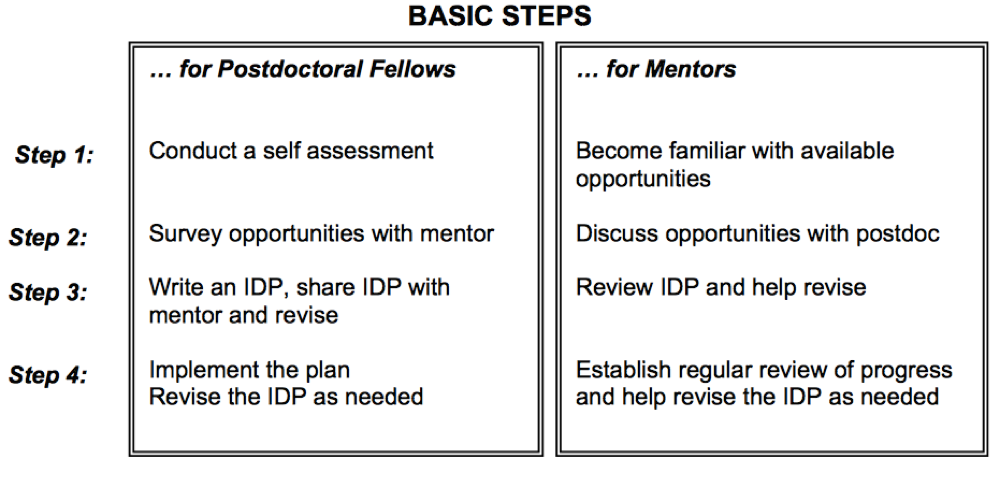
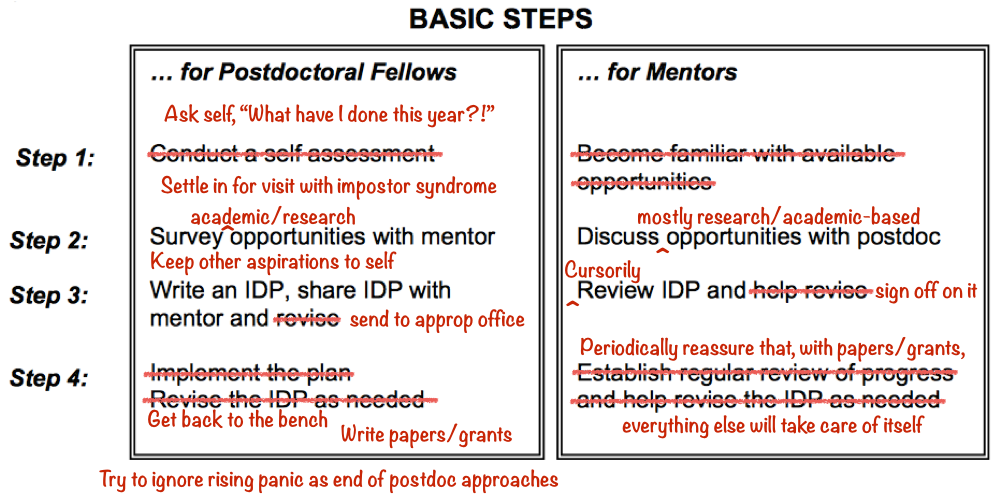
myIDP gave me a place to start. The structure helped keep me from feeling completely overwhelmed.
And it gave me a tangible step in an amorphous process. There was a start and an end. It had taken a small part of a day to complete, but it was progress.
So I came to the end of myIDP and was presented with a list of categories and career paths. What was I supposed to do with this?
https://twitter.com/biochembelle/status/555422942784675841
I didn’t expect myIDP to tell me where I was destined to go next. I had no intention of letting a computer algorithm and a faceless expert panel determine what I should do with the rest of my life (nor was that the intention of its creators).
What I took from it were seeds. Some things on the list resonated deeply and immediately. Some I thought were worth further consideration. And some held no interest for me whatsoever. Policy-related? Ding! Intellectual property? Possibly. Sales and marketing? No. Way.
Then I started exploring.
I started reading. First, I went with the resource links in myIDP because they were right there. But I expanded from there. (There are all sorts of resources are available at our fingertips, thanks to Google. Check out MySciCareer, for example.)
I started asking questions. I’d met someone who was a technical writer for a company some weeks before, so I sent an email. I cast a question to Twitter. I chatted with people at events.
I tried to keep an open mind, but I also (unscientific as it sounds) listened to my gut. The assessment part of myIDP and discussions with people who knew me had solidified the idea that I had a reasonably broad set of skills and interests. Looking back, I realize there were a couple of big questions. Could I imagine the job being sustainable (professionally, personally, financially), at least for a few years? What sort of broader impact on science or society could it have?
See, the exploration phase wasn’t just about investigating options. It was about finding self.
Even at the start of the process, I was parsing options into bins. The collections seemed disparate at first glance. But this was informative too, as I began considering the common themes. Why did I connect to certain categories but not others? What appealed to me among different paths? What was I looking to get out of my job?
When I first decided to consider a course change, I hadn’t committed to it. But as I looked at the possibilities and where they could take me, I began to realize that what I wanted was not to be found in researching biochemistry and cell biology of inflammation. I can’t point to a date and say, “That’s the day I knew I would abandon the tenure track.” It wasn’t an epiphanic flash. It wasn’t about leaving academia. Rather it was about pursuing a different purpose.
And I didn’t need to wait until I mapped out an elaborate plan to start doing things differently. It was time to take another step.
To be continued…


 Ever on & on